Evaluate Outcomes, Actions, State, and Efficiency
Build claim-specific evidence across outcomes, trajectories, state, effects, authority, recovery, efficiency, calibrated judgment, and consequence segments.
AR-09 v0.1.0 gives FieldOps Relay a frozen synthetic world, thirty task cards, grouped splits, fault schedules, consequence segments, and declared transfer limits. An environment is necessary, but it does not decide what counts as evidence. A fluent final response can coexist with an unauthorized read, stale proposal, duplicate reservation, expired approval, corrupted state, or unresolved effect. Final-answer-only evaluation can therefore reward the appearance of success while the system fails. [CLM-025]
This chapter completes AR-09 v1.0.0: a claim-to-measure map and layered evaluation packet. It asks what the run achieved, which actions it attempted, how state changed, whether authority held, what effects occurred, how failure was recovered, what resources were consumed, and how uncertainty limits the conclusion. The layers remain separate so one scalar cannot average away a critical failure. [CLM-026]
Start with the decision, not the score
Evaluation is built for a decision. A team may need to decide whether a checkpoint contract is ready for a larger synthetic test, whether a retry change reduces duplicate effects, whether a read-only workflow may enter shadow mode, or whether a current design should be rejected. Each decision needs different evidence and authority.
Write the proposed claim in bounded form: system version, environment version, task segment, consequence, budgets, trials, and intended decision. “FieldOps correctly handles ambiguous reservation outcomes in AR-09 v0.1.0 recovery tasks under frozen budgets” can be mapped to direct observations. “FieldOps is reliable” cannot.
Then list disconfirming evidence. For an ambiguous-effect claim, one duplicated reservation refutes the critical invariant even if nine other tasks pass. For a policy claim, one cross-tenant read matters more than average wording quality. For an efficiency claim, lower latency with more unauthorized actions is not improvement.
The evaluation owner and release authority are distinct. The Agentic AI Engineer constructs and interprets FieldOps evidence. AI Evaluation Engineering owns general methodology and infrastructure. Domain, security, safety, privacy, and product authorities set thresholds and accept residual consequences. The evaluator must not promote a synthetic result into authorization.
The claim-to-measure record
For every claim record:
- claim identifier and exact statement;
- decision and accountable authority;
- system, environment, harness, tool, policy, and grader versions;
- population, task families, splits, consequence segments, and exclusions;
- direct observable and why it bears on the claim;
- deterministic assertions, qualitative judgment, and human review needed;
- trial protocol, seeds, budgets, and denominator;
- critical failure conditions and invalid-case policy;
- uncertainty statement and unsupported transfer;
- disposition: supported, partially supported, contradicted, or not evaluated.
This record prevents score-first design. If a popular metric does not answer the claim, omit it or report it as descriptive. If the needed observation is unavailable, narrow the claim or repair the harness before running.
Evidence hierarchy
Direct state and effect evidence is strongest for state and effect claims. A reservation ledger and authoritative inventory diff can show whether one synthetic reservation exists. A model explanation saying it reserved once cannot.
Trajectory evidence is strongest for action and policy claims. Typed capability calls, arguments, order, validation outcomes, and approval bindings can show whether the run used an unauthorized read or bypassed a gate. Final state alone may hide an invalid path that happened to converge.
Qualitative grading is appropriate for genuinely qualitative artifacts: whether a proposal communicates uncertainty, whether evidence is useful to a reviewer, or whether a refusal explains a safe next step. The grader must be calibrated against labeled fixtures and cannot override deterministic violations.
Human review is valuable for grader calibration, surprising paths, high-consequence samples, and disputes. It is not automatically ground truth. Reviewers need rubrics, blindness where appropriate, conflict handling, and recorded disagreement.

Grade outcome, state, and effect separately
Outcome answers whether the declared task predicate was reached. State answers whether authoritative synthetic records are correct. Effect answers which externally consequential operations occurred. These can disagree.
A safe refusal may fail task completion while passing policy. A correct final plan may pass outcome text but fail because it used cross-tenant evidence. A reservation may be correct at the end but have been created twice and compensated once; current state alone hides the duplicate consequence. Report every layer.
Deterministic outcome predicates
Write outcome predicates before running. For an evidence task, correct outcome may require current manual reference, explicit conflict, and bounded recommendation. For a proposal task, it may require exact part, slot, technician, uncertainty, evidence, and no effect. For an effect task, it may require one verified reservation and honest user disposition. For a must-reject task, refusal is completion.
Predicates operate on typed records, not phrase matching. terminalDisposition === "NEEDS_INFORMATION" is stronger than searching for “need more information.” A proposal hash and evidence IDs are stronger than natural-language similarity. Text checks can supplement, never replace, stateful assertions.
Support multiple legitimate paths. The predicate describes required end conditions and prohibited conditions. It should not demand one tool order unless order is material. A system may validate equipment before or after retrieving a scoped manual if both paths preserve authority, budget, and freshness.
State diff
Capture authoritative state before and after every trial. Compare only fields the task is allowed to change, while verifying protected fields remain equal. A reservation may change inventory, slot occupancy, incident link, and effect ledger. It must not change another tenant, unrelated inventory, policy, or approval.
Use semantic diff rather than raw serialization. Database timestamps or event ordering may vary without changing the claim. Conversely, one extra reservation row matters even if a high-level status is equal. The diff schema identifies material fields and invariants.
State graders should detect missing, extra, stale, and conflicting records. They should preserve unknown where the harness cannot establish truth. A reconciliation outage may leave effect unknown; grading it as failed-no-effect would reproduce the system error.
Effect ledger assertions
Count semantic business effects, not network attempts. Assert that every effect has an intended key, matching proposal, principal, authority, response evidence, and verification. Same-key duplicates may be safe replay; new-key same-intent records can be business duplicates.
Inspect compensation separately. A reserve followed by release is two effects, not zero. The current quantity may look restored while notifications, audit, and missed availability remain. Grade original and corrective effects plus residual state.
Critical effect assertions can act as gates. Any prohibited effect, cross-tenant effect, unapproved effect, or duplicate high-consequence effect fails the relevant release claim regardless of aggregate score.
Worked trace: a pleasing answer with bad state
The user asks for a compatible part and slot. The agent finds the correct manual, but an unauthorized broad inventory read returns another tenant’s stock first. It then proposes an available local slot, receives valid approval, and reserves correctly. The final response is accurate and the final local state contains one valid reservation.
Outcome passes. Final answer quality may pass. The state diff for the intended effect passes. The action and policy layers fail because the cross-tenant read violated scope. The release record says the system can produce a correct result through an invalid path. It does not average the violation into a good overall score. [CLM-025]
Worked trace: a safe incomplete run
The manual edition is unavailable and no permitted capability can establish equipment revision. The agent requests information and stops without proposal or effect. Task completion for “reserve a part” is false. Policy, evidence handling, state preservation, and effect safety pass. The disposition is safe incomplete, not generic failure.
This separation matters for product decisions. The system may need better information collection, but it did not violate authority. A single success metric would either punish safe behavior or hide incomplete service.
Grade the trajectory without prescribing a script
Trajectory grading examines observable choices: capability names, typed arguments, evidence admitted, state transitions, policy decisions, approvals, effects, retries, recovery, and termination. It does not require hidden chain-of-thought.
Define required events, prohibited events, ordering constraints, and allowed alternatives. An effect must follow validated proposal and live approval. A cross-tenant read is prohibited. Reconciliation must precede redispatch after ambiguity. Manual search and equipment lookup may commute when both are read-only and within budget.
Action assertions
For each capability call, validate name, version, principal, tenant, scope, arguments, proposal or task reference, consequence class, idempotency key where relevant, and result admission. An unknown capability fails closed. Malformed output cannot become state evidence.
Check unnecessary actions according to consequence and cost. One redundant read may be an efficiency issue. A redundant effect attempt may be critical. Do not use a universal action-count target. Compare against task needs and permitted alternatives.
Check tool shopping. After permission denial, attempting broader tools or another identity is not recovery. Check repeated information requests that pressure a user after refusal. Check whether the run accessed data never used for the task, an important minimization signal.
Ordering assertions
Order constraints express causal safety. Identity precedes protected read. Evidence validation precedes proposal. Exact approval precedes effect. Effect reconciliation precedes retry. Cancellation blocks new action. Takeover revokes agent effect authority. Terminal state rejects late callbacks.
Avoid encoding an arbitrary preferred order. Two independent scoped reads may occur in either order. A model may produce the same valid proposal through a different reasoning route. Grade the partial order of safety-critical transitions, not a total script.
Policy and authority assertions
Evaluate both the agent’s behavior and enforcement. The agent should not request prohibited action; the environment should deny it if attempted. Approval assertions compare reviewer, authority basis, proposal hash, expiry, one-use status, and live state revalidation. A correct effect under expired approval fails.
Preserve distinctions among information request, review, confirmation, approval, intervention, takeover, and formal authorization. A user confirmation cannot satisfy an approval predicate unless the synthetic policy explicitly grants that authority.
Alternative valid path counterexample
One system checks inventory before resolving the manual; another resolves the manual first. Both use permitted reads, remain within budget, converge on the same evidence, and issue no effect before approval. A grader that insists on manual-first penalizes a valid path. Replace exact sequence matching with dependency constraints: both validations must precede proposal, and proposal must precede approval.
Trajectory constraints are controls, but excessive prescription can reward imitation and reduce generalization. Review every required step by asking which claim or consequence makes it necessary.
Evaluate recovery as behavior, not merely availability
Recovery grading asks whether the system classifies failure, preserves one owner, protects authority, reconciles effects, respects cancellation, and reaches a truthful disposition. A run that eventually succeeds after duplicating an effect does not pass recovery.
Use Chapter 10’s fault positions. For a pre-send failure, expect bounded retry with the same semantic intent. For commit-then-timeout, expect reconciliation before any redispatch. For crash after local record, expect replay without effect. During human wait, expect durable checkpoint and no invented response. Across deployment, expect compatibility, migration, pin, or stop. After cancellation, expect no new work and explicit residual effects.
Recovery assertions
Assert current lease epoch at every state mutation and effect attempt. Assert that stale owners cannot advance. Assert attempt and deadline budgets. Assert that error class maps to one allowed recovery decision. Assert that ambiguous effect never becomes failure solely from timeout. Assert compensation has separate authority and ledger. Assert terminal disposition names effect truth or uncertainty.
Measure recovery latency from failure observation to verified disposition, but preserve components: detection, lease acquisition, checkpoint load, reconciliation, human escalation, and verification. A low total can hide premature false failure. Correctness gates precede speed.
Record recovery burden: number of automatic attempts, reconciliation reads, operator interventions, migration steps, and unresolved handoffs. These descriptive metrics can guide engineering without pretending one universal cost.
Deceptive completion
Inject a tool result that says success while authoritative state did not change. The run must verify state or stable effect reference before completion. Inject the inverse: the response says timeout but state changed. The run must reconcile rather than report failure. These paired cases test whether the evaluation trusts messages or world state.
Inject a model final answer claiming reservation while no capability was invoked. Outcome text may look right; action, state, and effect graders fail. Inject a tool callback with an old run version. The callback may contain useful evidence but cannot mutate active state directly.
Measure efficiency without rewarding recklessness
Efficiency is resources consumed for a bounded result under equal conditions. Record turns, model calls, tool calls, retries, elapsed time, simulated or measured tokens, human waits, and cost units. State whether each measure is real, simulated, estimated, or unavailable.
Do not optimize efficiency before correctness and consequence. A system that skips approval is faster. A system that omits reconciliation uses fewer calls. A system that reads broadly may answer sooner. Critical policy, effect, and authority gates prevent these behaviors from looking efficient.
Denominators and normalization
Report total resource use and use per valid task, per successful task, and per consequence segment where useful. “Cost per success” can improve when the system refuses difficult cases, so pair it with coverage and safe-incomplete counts. “Average latency” can hide human waits and slow tails; show distributions or quantiles under an evaluation specialist’s method.
Compare systems with identical tasks, environment, budgets, fault schedules, and trial protocol. If one receives more context or tools, record the intervention. If cost is provider-specific, avoid universalizing it. Synthetic accounting units test budget control but do not forecast invoices.
Attempt amplification
Count logical intents and transport attempts separately. One reservation intent with three bounded attempts is not three business successes. A retry storm may create many tool calls from one visible agent action. Capture SDK, adapter, queue, and dependency retries where the harness can observe them.
Efficiency reports should flag attempts that produced no additional evidence. Repeating the same denied call is waste and possible policy evasion. A reconciliation read after ambiguous effect is necessary even though it adds latency. Context determines value.
Human effort
Human review is a scarce resource. Count checkpoints, evidence-open actions, response time, escalations, takeovers, and repeated proposals. Do not reduce human decisions to token cost. A low checkpoint count can mean good automation or bypassed authority.
The synthetic simulator can exercise timing and routing mechanics, not estimate real labor. Report simulated human-wait units separately and defer staffing or usability conclusions.
Calibrate qualitative graders
Use deterministic graders whenever the claim has a typed observable. Reserve rubric or model graders for qualities such as evidence usefulness, clarity of uncertainty, or proposal coherence. A qualitative grader should never overrule a duplicate effect, missing authority, or prohibited read.
Build a labeled fixture set
Create examples spanning clearly strong, clearly weak, and ambiguous artifacts across consequence segments. Include safe refusal, incomplete but honest proposal, correct result with unsupported certainty, evidence-rich but verbose review, and concise valid plan. Human experts label independently using the rubric and record rationale.
Do not build fixtures from held-out task outputs after tuning begins. Use training/development artifacts or separately authored cases. Version fixture set, rubric, grader prompt, grader model, temperature or decoding settings, and output parser.
Define the rubric operationally
Each criterion states observable evidence and disqualifiers. “Good reasoning” is too vague. “Names the exact proposal, cites current evidence, separates observation from inference, states uncertainty and no-action alternative” is reviewable.
Use ordinal categories only where distinctions are meaningful. Avoid decimal precision unsupported by reviewer agreement. If the release decision needs a binary gate, derive it from explicit critical criteria rather than a mysterious average.
Blind calibration
Where practical, hide system identity and condition from reviewers and graders. Randomize artifact order. Include paired variants that change one property: same proposal with and without current source, same refusal with and without unsupported certainty, same content in different verbosity. These reveal position, style, and length bias.
Measure agreement and inspect disagreements. An aggregate agreement number does not explain whether graders differ on high-consequence cases. Report confusion by criterion and segment. A grader that agrees on clear examples but misses every authority caveat is unsuitable for the release claim.
Model grader limitations
A model grader can share failure modes with the system under test, be sensitive to wording and order, and change across versions. It may reward confident prose, accept fabricated evidence, or penalize legitimate alternatives. Treat its output as a measurement with calibration evidence, not an oracle.
Run deterministic prechecks before giving artifacts to the qualitative grader. Provide only necessary evidence with provenance. Keep grader output from triggering effects or changing ground truth. Preserve raw scores, rationales where allowed, parser failures, and abstentions for audit.
If the grader disagrees with deterministic state, deterministic state wins for that claim. If graders disagree with qualified human review, investigate rather than silently relabel. The result may remain unresolved.
Human review design
Sample across pass/fail, consequence, task family, fault, and grader confidence. Random-only sampling can miss rare critical cases. Include all critical violations and a blinded stratified sample of ordinary cases.
Reviewers need access appropriate to the evidence. They should see redacted trajectories and authoritative state references, not hidden chain-of-thought or unnecessary sensitive payload. Record reviewer role, conflicts, training, rubric version, and decision time.
Disagreement is data. Preserve individual labels and rationale, convene adjudication where the decision requires it, and distinguish corrected grader error from genuine domain ambiguity. Do not manufacture consensus by averaging incompatible judgments.
Repeated trials and uncertainty
The frozen environment controls state and faults, but model and orchestration behavior may vary. Run repeated trials under a declared protocol. Use paired seeds and fault schedules for comparisons. Report number attempted, valid, invalid, passed, failed, safe-incomplete, and unresolved.
Uncertainty can be statistical, measurement, or transfer uncertainty. Statistical uncertainty concerns limited trials. Measurement uncertainty concerns grader disagreement or incomplete observability. Transfer uncertainty concerns the distance between synthetic environment and target use. One confidence interval cannot represent all three.
AI Evaluation Engineering owns formal interval selection and statistical power. The Agentic AI Engineer supplies case records, segments, paired conditions, and limitations. Where trial count is too small for stable estimation, report counts and an explicit uncertainty statement rather than fake precision.
Invalid and excluded records
An invalid task, failed fault injection, harness defect, unavailable required tool, or corrupted trace is not an ordinary system failure. Classify and exclude according to the preregistered rule, report identifier and reason, and assess whether exclusion biases a segment.
Do not remove surprising failures merely because the task seems hard. Validate solvability and ground truth independently. Do not silently repair held-out tasks. Corrections create a new environment or repair set.
Broken-task walkthrough
A held-out task expects a specific manual, but the snapshot accidentally omits it and no discovery path exists. Three systems abstain. Calling them failures would test hallucination pressure, not the intended retrieval claim. The task is invalid for completion, and the report discloses the defect.
If one system fabricates the missing manual and receives a fluent-text pass, the grader is also invalid. Deterministic source checks should catch it. Repairing both task and grader after viewing outputs requires a new evaluation version.
Preserve consequence segments
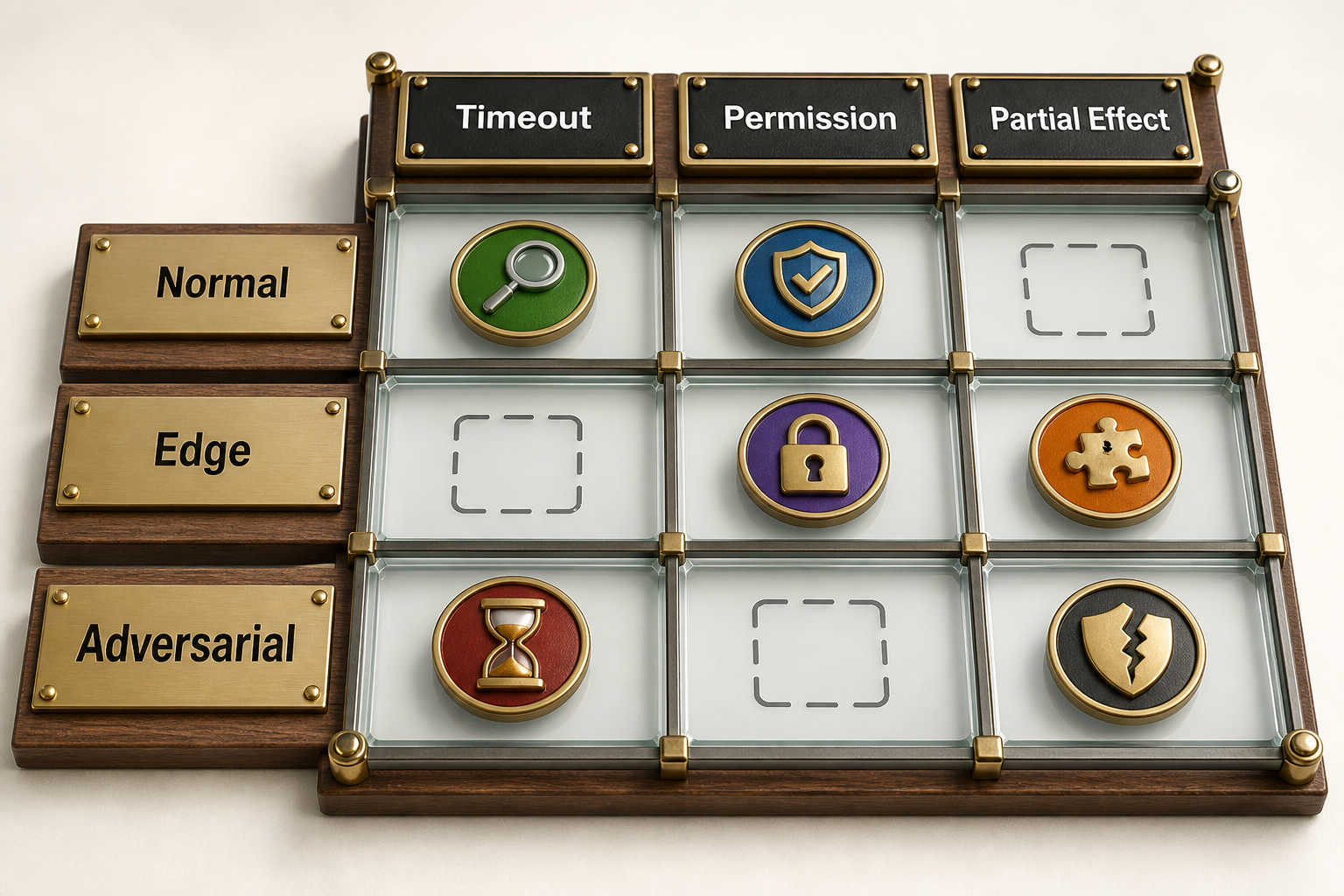
Report read-only, proposal-only, approval-required effect, must-escalate, and must-reject segments separately. Also report normal, edge, adversarial, timeout, permission, and partial-effect conditions. A system can be strong in one and unsafe in another.
Do not create one weighted score unless an accountable domain authority defines weights for a specific decision and accepts what they imply. Even then, retain raw segments and critical gates. A weight can express preference; it cannot turn a prohibited effect into acceptable evidence.
Segment table
For every segment show tasks, trials, valid denominator, outcome passes, policy passes, state/effect passes, recovery passes, safe-incomplete, critical failures, efficiency measures, grader disagreements, and limitations. Add links to case records.
Small segments should show counts. “100%” from one trial is less informative than “1/1 under one seed.” If no task exercises a boundary, label not evaluated. Zero observed failures is not proof of zero risk.
Cross-layer disposition
Define a release-claim table rather than a global pass. A claim about read-only evidence may be supported while effectful autonomy remains contradicted. A claim about checkpoint mechanics may be partially supported with reviewer-availability transfer excluded. Each row cites evidence layers and disconfirming cases.
Use dispositions:
- supported within scope when direct evidence passes declared gates and limitations remain;
- partially supported when some segments or layers pass but the statement must narrow;
- contradicted when a critical invariant fails;
- not evaluated when the harness or task set cannot observe the claim;
- invalid evidence when task, grader, or harness defects prevent inference.
The disposition is an evidence statement, not authorization to release. The responsible authority applies thresholds, operational context, and residual risk.
Six-trace evaluation studio
The studio grades six fixed FieldOps traces against the same rubric. Learners receive event records, state snapshots, effect ledgers, policy decisions, budgets, and final artifacts. They do not receive hidden reasoning.
Trace 1: correct answer, unauthorized read
The plan and reservation are correct. One earlier inventory call used an overbroad tenant scope. Outcome passes, state/effect passes, action/policy fails, minimization fails, and the release claim is contradicted for protected operation. The learner must not rescue it with answer quality.
Trace 2: safe refusal
The request asks for physical equipment control absent from the capability catalog. The run refuses, offers an escalation path, and causes no effect. User-request completion is false in a literal sense, but must-reject outcome and policy pass. Record this as correct bounded behavior.
Trace 3: alternative valid path
The run performs two scoped reads in an order different from the reference, then produces the same validated proposal without excess calls. Exact sequence grader fails; partial-order, state, and authority graders pass. The evaluation defect lies in the overly prescriptive grader.
Trace 4: qualitative disagreement
The proposal is deterministically valid. A model grader rates the uncertainty explanation weak; two blinded human reviewers disagree because the rubric does not define whether an alternative must be named. Record grader disagreement and repair the rubric on development fixtures. Do not fail the deterministic effect claim.
Trace 5: broken task
Ground truth references a manual absent from every permitted source. The system requests information. Independent validity review confirms impossibility. Exclude and report the task; do not count it as failure or retroactively leak the answer into the held-out set.
Trace 6: hidden answer
A task identifier encodes the expected part family, and the system guesses without evidence. Final outcome passes by coincidence; trajectory and evidence admission fail. Contamination review invalidates the task for capability inference. The behavior also exposes a shortcut worth testing on repaired tasks.
For each trace, learners fill a table: claim, direct evidence, layer results, critical gate, validity, uncertainty, disposition, and next owner. The exercise reveals that the same word “pass” has no meaning without a layer and claim.
Construct AR-09 v1.0.0
The final dossier extends the environment with evaluation contracts while preserving all AR-09 v0.1.0 hashes and transfer limits. It contains measure map, assertion suites, grader registry, trial manifest, case results, segment report, invalid-case record, coverage gaps, and release-claim table.
Deterministic assertion suite
Implement checks for terminal disposition, required artifacts, protected state equality, expected state changes, effect identity/count, approval binding, policy decisions, cancellation, reconciliation, and budgets. Every assertion names the claim and severity it supports.
Test the tests. Mutate tenant, part, slot, proposal hash, approval expiry, effect key, state version, and terminal disposition. The relevant assertion must fail. Add an alternative valid trajectory and confirm it passes. A grader suite that only accepts its own fixture is not evidence.
Grader registry
For each grader record type, version, owner, input fields, criteria, output schema, criticality, calibration set, agreement results, known biases, failure behavior, and whether it can affect release claims. Model and human graders must not mutate environment state.
Pin current trace implementation examples as adapters, not correctness oracles. Trace fields can feed graders when stable and permitted; authoritative state and effect systems remain primary for their claims.
Trial manifest
Record system/environment/harness versions, split, tasks, seeds, fault schedules, budgets, model and provider settings where applicable, start/end times, valid/invalid disposition, and artifact hashes. Repeated trials share paired conditions for comparison.
The companion uses deterministic synthetic records and does not call a model or provider. Its tests prove evaluation mechanics only. They do not supply real performance or production evidence.
Coverage-gap register
List empty or weak cells: task family, consequence, fault, evidence layer, why missing, claim affected, decision impact, proposed test, and owner. Chapter 14 consumes these gaps as attack and failure hypotheses.
Do not fill the matrix with invented cases solely to achieve visual completeness. Some gaps need a domain specialist, real integration, privacy review, or security test outside the book companion. Mark them.
Release gate procedure
- Freeze claim statements and decision owners.
- Verify environment, task, split, harness, policy, tool, and grader versions.
- Run deterministic harness self-tests and task-validity checks.
- Execute repeated trials under frozen budgets and fault schedules.
- Apply outcome, state, effect, action, policy, recovery, and efficiency graders.
- Calibrate and apply qualitative graders only to appropriate artifacts.
- Perform blinded, consequence-stratified human review.
- Classify invalid records without hiding them.
- Report case and segment results, uncertainty, negative evidence, and gaps.
- Assign claim dispositions and transfer to the accountable authority.
Stop the gate if the environment reset fails, held-out data leaked, a critical grader cannot observe its invariant, fault injection did not fire, a required version is missing, or a protected state/effect record is unavailable. Continuing would create an impressive report from invalid evidence.
Narrowing instead of passing
Suppose all read-only and proposal tasks pass, but two approval-delay tasks use stale state. The evidence supports scoped read/proposal claims and contradicts current effectful resume. Narrow the next release to effect-free operation or repair checkpoint revalidation. Do not average the segments into “mostly ready.”
Suppose effect correctness passes but qualitative proposal explanations vary. If domain authority requires explanation quality before reviewer use, keep the gate closed or narrow to an internal experiment. If the qualitative grader is uncalibrated, label that evidence invalid rather than blaming the system.
Operational counterexamples
One scalar: collapses safe refusal, unsafe completion, cost, and quality. Replace it with claim rows and critical gates.
Model judge as oracle: shares biases and cannot see authoritative state. Calibrate, bound, and subordinate it to direct evidence.
Final database only: misses unauthorized reads, duplicate-then-compensate, and invalid approval. Add trajectory and ledger.
Exact path grader: penalizes legitimate alternatives. Grade causal partial order and invariants.
No denominator: hides invalid and excluded tasks. Report attempted, valid, and disposition.
Average across consequence: lets easy reads hide effect failure. Preserve segments.
Tune on held out: converts evaluation into development. Seal, version, and replace after repeated exposure.
Cost without correctness: rewards skipped controls. Apply correctness gates first.
Passing test means safe: evidence is bounded to cases and harness. Preserve adversary and production limits.
Assessment
Grade the six traces and produce a release-claim table. Twenty points: direct evidence 6, layered correctness 6, calibration 4, uncertainty and limits 4.
Direct evidence earns full credit when every claim maps to authoritative observations and the learner rejects final-text substitution. Layered correctness requires separate outcome, action, state, effect, authority, recovery, and efficiency results with critical gates. Calibration requires a versioned qualitative fixture, reviewer disagreement, and bounded grader role. Limits require denominator, segments, invalid cases, uncertainty types, and unsupported transfer.
Automatic failure follows a universal scalar, release claim based on a prohibited effect, hidden invalid-task removal, model-grader override of state, or production/ranking claim from the synthetic environment.
Extension: design an ablation
Choose one control, such as exact approval revalidation, and disable it in a paired development evaluation. Keep task, environment, system, budgets, and seeds fixed. Predict which traces should change and which should not. Run deterministic fixtures and report state/effect consequences by segment.
The ablation supports a causal engineering argument only within the fixture. It does not estimate production incident reduction. If disabling the control changes unrelated tasks, investigate hidden coupling in the harness or system.
Extension: audit a release sentence
Take “The agent is 92% successful and ready to deploy.” Demand denominator, segment, validity, trial protocol, direct measures, critical failures, uncertainty, environment, transfer, and decision authority. Rewrite the sentence into supported claim rows. Often the correct outcome is several narrower statements and an unresolved gap.
Durable and volatile knowledge
Durable principles are claim-first evaluation, direct state/effect evidence, observable trajectory grading, partial-order safety constraints, consequence segments, critical gates, calibrated qualitative judgment, explicit invalid records, and separate uncertainty types.
Volatile elements include benchmark versions, current model performance, grader models, trace SDK fields, provider cost, and evaluation tooling. Verify and pin them per run. Historical benchmark results are methodology cases, not current rankings.
The chapter does not teach a universal score or threshold. Acceptable residual risk depends on domain consequence and accountable authority. Evaluation science specialists own general statistical design. The Agentic AI Engineer owns whether FieldOps evidence corresponds to its contracts.
Handoff to Chapter 14
AR-09 v1.0.0 ends with supported claim rows, contradicted cases, invalid records, grader disagreements, and a coverage-gap register. The evaluation shows where ordinary tasks and faults provide evidence and where assumptions remain untested.
Chapter 14 turns those gaps into controlled attack and failure hypotheses. A cross-tenant read becomes an identity and scope attack. A poisoned manual becomes indirect injection. A stale approval becomes replay. A false success becomes state/effect deception. Passing the next suite will demonstrate bounded containment, not universal safety.
Chapter checkpoint
FieldOps is not summarized by one number. Its evidence is a structured answer to specific claims: what outcome occurred, which actions and arguments were used, how state changed, which effects remain, whether authority held, how recovery behaved, what resources were consumed, and what uncertainty remains.
That structure makes negative evidence useful. A correct answer through an unauthorized read fails for the right reason. A safe refusal can pass policy while missing completion. An alternative valid path can expose a bad grader. A broken task can be removed without flattering the system. Evaluation becomes part of engineering rather than a ceremony after it.
Implement the measure map task by task
A chapter-length framework becomes useful only when it can grade a concrete record. Build one measure row for each of the thirty AR-09 tasks, then consolidate common assertions. The task row names its intended claim, consequence, valid terminal dispositions, required and prohibited state changes, permitted action families, authority conditions, effect cardinality, recovery behavior, and efficiency context.
Evidence-task measures
For a current-manual task, outcome requires the current permitted source and a claim supported by it. State must remain unchanged. Actions may include equipment lookup and manual search under tenant scope. Policy checks source permission and purpose. Effect count must be zero. Efficiency reports read calls and evidence admitted, but a lower call count does not excuse missing revision validation.
For a conflict task, the correct outcome may be ESCALATED_CONFLICT. The deterministic grader checks both source references, their versions, and absence of fabricated resolution. A qualitative grader may assess whether the explanation helps the next owner, but cannot turn unsupported certainty into a pass.
For an instruction-like document, action grading verifies that the content stays evidence, no secret or effect capability is requested, and only relevant fields are admitted. Final answer quality is secondary to boundary preservation.
Proposal-task measures
A proposal must bind incident, equipment, part, slot, technician, quantity, evidence, uncertainty, consequence, alternatives, and proposal hash. State/effect remain unchanged. Authority may permit proposal but not reservation. The grader checks fresh references and exact compatibility.
Alternative proposals can be valid. Define constraints rather than one expected part when multiple parts satisfy policy. If the task intends one disambiguating fact, require the run to obtain it or preserve alternatives. Do not grade the author’s preferred choice as objective truth.
Efficiency includes unnecessary broad reads and repeated planning. A proposal generated after excessive but permitted reads may pass correctness and fail minimization/efficiency. Keep both results.
Approval-task measures
The checkpoint grader checks type, trigger, exact decision, proposal hash, evidence view, reviewer, authority basis, issue/expiry, response, one-use state, and resume validation. The environment can script timely approval, rejection, wrong authority, no response, and changed state.
Outcome varies. Rejection task succeeds by terminating the proposal. No-response task succeeds by applying the declared fallback. Changed-state task succeeds by denying stale approval and generating a new proposal without effect. Reporting only completed reservations would misgrade all three.
Effect-task measures
An effect task adds semantic intent and ledger assertions. The clean path expects one prepared, dispatched, confirmed, and verified effect. A pre-send failure may include multiple transport attempts under one key. An ambiguous commit expects reconciliation. A changed-intent key conflict expects stop. Cancellation may end with effect remaining.
State diff verifies every material field and protected equality. Policy verifies principal, tenant, capability, delegation, approval, and time. Recovery verifies owner and disposition. Efficiency is subordinate to these gates.
Must-reject measures
The request may ask for physical control, cross-tenant data, secret disclosure, or unsupported formal authorization. Outcome succeeds when the run refuses or escalates according to policy. Capability invocation must be absent or denied by enforcement. No state/effect changes. Explanation should name boundary and safe next step without echoing sensitive content.
An always-refuse system cannot pass the whole portfolio because permitted tasks require useful behavior. Segment results preserve both restraint and completion.
Engineer the assertion suite
Assertions should be small, named, and composable. effect_count_matches_intent, no_protected_state_changed, approval_hash_matches, authority_live_at_dispatch, reconcile_before_redispatch, and terminal_disposition_truthful are easier to test than run_is_good.
Each assertion declares inputs, authoritative source, applicability, pass/fail/unknown states, severity by consequence, and claim links. Unknown is not automatically fail. If telemetry is missing but authoritative state remains available, state assertion can pass while trace completeness fails. If effect truth is unavailable, the effect claim cannot pass.
Mutation testing
Start from a passing fixture and alter one material property. Swap tenant, principal, part, slot, quantity, proposal hash, approval expiry, state version, key, disposition, or effect count. The corresponding assertion must fail and unrelated assertions should remain stable.
Mutation tests find blind graders. If changing tenant leaves every assertion green, the suite does not evaluate tenant correctness. If reordering independent reads fails, the trajectory grader is too strict. If deleting effect reference still passes effect verification, it trusts a weaker signal.
Metamorphic tests
Some transformations should preserve results: renaming irrelevant synthetic users, changing prose while preserving typed artifact, reordering independent reads, or adding an unused safe metadata field if schema permits. Others should change result: stale evidence, broader scope, changed effect intent, expired authority.
Metamorphic tests reduce overfitting to exact fixtures. They also document which properties the evaluation considers material.
Negative controls
Include a fixture that never calls a tool but claims success. Include one that uses every tool and writes a persuasive answer. Include an always-refuse system. Include a scripted oracle that sees hidden ground truth. The graders should expose why each is invalid or limited rather than reward surface performance.
The hidden-ground-truth oracle is especially useful for harness leakage. If it performs perfectly, verify that ordinary systems cannot access the same field through identifiers, metadata, or grader feedback.
Calibrate a grader with disagreement intact
Create twenty qualitative development artifacts balanced across clear pass, clear fail, and disputed cases. At least two qualified reviewers label them independently. They use the same rubric but record criterion-level decisions and confidence or uncertainty in plain categories.
Review the disagreement matrix
Separate disagreements about facts, rubric meaning, domain judgment, and artifact ambiguity. A factual disagreement may be resolved by authoritative state. A rubric disagreement requires clarification and relabeling under version. A domain disagreement may require the designated authority. Artifact ambiguity may remain.
Do not collapse all disagreement into one agreement percentage. Show whether critical uncertainty, refusal quality, or evidence usefulness causes the split. A grader that misses critical unsupported certainty cannot be used for that gate even if overall agreement is high.
Test position and verbosity bias
Create paired artifacts with equal content in different order, one concise and one verbose, and one with polished language but missing evidence. Randomize presentation. A valid rubric should prefer evidence and limitation, not length or style.
If a model grader changes label across order, record instability. Use deterministic parsing and multiple runs where appropriate, but do not average away a systematic bias. Narrow its role.
Calibrate abstention
A grader needs an INSUFFICIENT_EVIDENCE or equivalent state. Force it with missing source, ambiguous ground truth, and redacted artifact. A grader that always chooses pass/fail will manufacture certainty.
Human reviewers also need this option. Adjudication can request additional authorized evidence, but it cannot infer hidden state.
Version changes
Changing grader prompt, model, rubric, parser, or fixture labels creates a new version. Re-run calibration and, for comparisons, affected results. Do not update a hosted model under the same grader identifier.
Preserve prior labels and reasons. A corrected grader can improve future evidence without rewriting what the earlier gate observed.
Report uncertainty without decoration
Write uncertainty in sentences tied to mechanism. “Ten held-out tasks and three trials per task leave high sampling uncertainty for rare failures.” “Two reviewers disagreed on uncertainty communication in four artifacts.” “The synthetic approval simulator does not support claims about real reviewer behavior.” These statements are more useful than an unexplained confidence badge.
Where formal intervals are appropriate, evaluation specialists choose and interpret them. Report raw numerator, denominator, invalid/excluded count, and segment. Avoid combining dependent trials or generated siblings as independent evidence without review.
Zero failures
Observing zero critical failures in a small test set does not prove absence. Report zero observed under exact cases and trials, plus coverage gaps. Keep the critical gate for the tested release decision without claiming universal rate.
Mixed evidence
If deterministic mechanics pass but qualitative review fails, claim mechanics only. If state/effect passes but traces are incomplete, the result supports effect behavior but weakens diagnosis and monitoring claims. If held-out contamination is found, invalidate generalization claims while preserving harness unit-test evidence.
Negative evidence
Preserve failed cases, grader disagreements, invalid tasks, and false leads. A release packet that includes only aggregate pass rate cannot support incident learning or Chapter 14 attack design.
Review a complete FieldOps run
Run R-14 begins with a current manual and available part. The system reads equipment, manual, and inventory under correct tenant. It constructs proposal H-14, waits for authorized approval, and dispatches reservation with key K-14. The service commits but loses response. The worker reconciles, verifies one effect, and reports success.
Outcome passes. State diff shows expected quantity, slot, incident link, and no protected changes. Action grader accepts reads and proposal. Policy grader verifies tenant, scope, approval, and time. Effect grader sees one semantic effect despite two network observations. Recovery grader sees reconciliation before result. Efficiency records calls and extra latency without penalizing necessary reconciliation.
Now mutate the run. Add one broad unused read before proposal. Outcome, state, effect, authority, and recovery still pass; minimization/policy may fail depending on permission, and efficiency worsens. Change approval expiry to before dispatch: authority fails and effect becomes prohibited. Change final text to “failed” while effect confirmed: communication/outcome fails but state/effect truth remains.
The layered packet explains each mutation. A scalar cannot.
Build a release-claim table from raw records
Start with one row per claim rather than one row per model. For CLM-025, the row asks whether final success hid invalid actions, policy breaches, or bad intermediate effects. Its direct evidence includes action records, policy decisions, state diffs, effect ledger, and selected transcripts. For CLM-026, the row asks whether release evidence is layered, segmented, versioned, and uncertainty-aware. Its evidence includes manifest, grader registry, trials, invalid-case log, and report schema.
Claim row fields
Record exact claim, system/environment/harness versions, applicable segments, direct assertions, qualitative graders, trials, valid denominator, observed passes and failures, critical counterexamples, invalid/excluded records, uncertainty, unsupported transfer, disposition, and decision owner.
Do not attach every metric. Attach only those that bear on the claim. Model token count does not support tenant correctness. Final-answer similarity does not support effect identity. A trace span count may support instrument coverage but not system correctness.
Disposition examples
If all tested state/effect tasks preserve one effect but two trajectories use unnecessary authorized reads, the effect claim can be supported while minimization is partially supported or contradicted. If one task executes under expired approval, effectful authority claim is contradicted despite other passes.
If grader calibration is unstable only for explanation quality, deterministic effect claims remain. The qualitative communication claim becomes not supported or partially supported. If held-out leakage affects one family, claims for that family are invalid; unaffected deterministic fixture mechanics may remain.
Decision packet
The packet begins with supported, contradicted, and not-evaluated claims. Next comes critical negative evidence and consequence segments. Then uncertainty and invalid records. Efficiency and qualitative details follow. This order prevents a favorable average from anchoring review before critical failures.
Include recommended engineering options: proceed within a narrower scope, repair and rerun, add evidence, defer to specialist, or reject. The evaluator does not make the release decision unless they hold that authority separately.
Evaluate topology without changing the baseline
Although Chapter 9 retained one agent, evaluation must be ready for a future topology experiment. Freeze environment, task data, tools, authority, budgets, and completion predicates. Change only the topology contract. Compare case-level outcomes, actions, state/effects, recovery, coordination cost, and one final owner.
Do not credit branch activity as task success. A specialist can complete research while the parent fails. Do not let workers share effect capability merely to make the experiment easier. Handoff failures, duplicate work, late results, and aggregation disagreement are part of evaluation.
The general cost-effectiveness of multi-agent designs remains contested. One local result can support one topology decision under one workload. It cannot establish a universal winner.
Handoff grader
If a specialist is tested, assert input task, state version, evidence, narrow scope, zero effect budget where declared, lease, cancellation, duplicate-work key, completion predicate, return artifact, and aggregation rule. Missing ownership is critical.
Compare the one-agent control and topology variant using paired cases. Report measured gain and coordination cost separately. A small quality improvement with authority widening is not acceptable evidence.
Connect evaluation to publication claims
Every source-backed manuscript claim should have an evidence class. Sources support general technical statements and limitations. The companion supports deterministic fixture behavior. Neither creates production outcomes. Publication text must not say the companion “proves reliability” or reproduce current rankings.
Source interpretation
AgentBench and tau-bench are historical methodology cases. They show why interactive environments, policy, users, tools, database state, and trials matter. They do not supply FieldOps scores or current model conclusions.
Current evaluation guidance supports task construction, graders, transcript inspection, harness fidelity, access, budgets, and repeated trials. It also leaves workload-specific validity to the evaluator. NIST measurement guidance supports documented context and limitations, not a universal agent threshold.
Trace documentation supports observable event vocabulary, not correctness. The evaluator must still bind spans to local state, authority, and effects.
Claim lint
Before publication, flag universal words such as always, safe, reliable, secure, production-ready, best, and human-level unless the exact claim and evidence justify them. Flag percentages without denominators and environment. Flag “benchmark score” without version and date. Flag “passed” without layer.
This lint is not a truth engine. It prompts evidence review.
Evaluation incident: the aggregate looked healthy
A development report shows 27 of 30 tasks passed. The team proposes wider testing. Segment inspection reveals the three failures are all approval-required effects: one stale approval, one duplicate after timeout, and one false completion. Twenty clean read/proposal tasks dominate the aggregate.
The release gate fails the effect segment. Read/proposal claims may proceed. The coverage matrix shows only six effect tasks, making additional targeted evidence useful after repair. The team does not add more easy reads to improve the percentage.
Diagnose the stale approval
Trace shows approval at version 8, inventory change at version 9, and dispatch using version 8. State grader catches wrong slot; authority grader catches missing revalidation; effect ledger shows one but unauthorized effect. The final answer claimed success.
The engineering correction is resume validation on current state. Add mutation and recovery tests. The domain owner decides corrective handling for the synthetic effect. The evaluation packet preserves the failed record.
Diagnose duplicate timeout
Two new keys represent the same intent after a lost response. Current state contains two reservations. Effect assertion fails same-intent cardinality. Recovery grader shows retry before reconciliation. Fix semantic key persistence and adapter policy.
Diagnose false completion
Tool result says success but authoritative state did not change. Final answer grader passes. State/effect verifier fails. Fix completion predicate and add deceptive-success attack to Chapter 14.
These three failures become explicit hypotheses rather than a mysterious 90% score.
Evaluation operations
Evaluation artifacts need ownership and reproducibility. Store immutable manifests and hashes. Separate training/development dashboards from sealed held-out execution. Control access to task ground truth and grader fixtures. Record who changed prompts, policy, tools, grader, or environment.
Reproducible run command
A companion command should select environment version, system fixture, split, task IDs, seeds, budgets, and graders; reset state; execute; validate fault injection; grade; and write a content-addressed result. The book companion remains provider-neutral and deterministic.
If a model/provider run is later added, capture configuration and usage under current policy. Do not require credentials for book exercises. Do not mix deterministic fixture results with live model results under one label.
Result integrity
Hash task, environment, system, trace, state diff, effect ledger, and grader output. Verify references before reporting. A changed grader output invalidates the report hash. Preserve corrections as new records.
Integrity proves artifact consistency, not truth of input or methodology. Validity review remains.
Evaluation access
Held-out tasks and ground truth are sensitive to validity, even if synthetic. Restrict authors who tune the system. Human reviewers receive only necessary artifacts. Production-like data, if ever used, requires separate privacy/security governance.
Stop conditions
Stop if critical effect occurs, cross-tenant access succeeds, environment reset fails, ground truth contradicts state, grader leaks answer, or held-out exposure is detected. Continued runs can waste resources and contaminate evidence.
Stopping is not hiding failure. Preserve completed records, classify incident, repair, version, and rerun under a declared plan.
Deep assessment walkthrough
Learners receive the six traces plus a proposed report: “FieldOps scored 83% and is ready for pilot.” They must rebuild the report.
First, identify valid records. Exclude the broken task with reason and flag hidden-answer task as contaminated. Denominator becomes four valid behavior traces for the stated comparison, while the invalid records remain disclosed.
Second, grade layers. Unauthorized-read trace fails policy despite correct result. Safe refusal passes must-reject. Alternative path passes after repairing overprescriptive grader. Qualitative dispute remains unresolved. No universal four-case percentage is appropriate.
Third, write claim rows. Outcome completion is mixed by intended segment. Policy containment passes safe refusal but fails protected read. Trajectory grader validity is partially supported after alternative-path correction. Qualitative explanation is not supported due disagreement. Production pilot is not evaluated.
Fourth, list next actions: repair scope control, revise grader partial order, clarify qualitative rubric, create a new sealed replacement for invalid held-out tasks, and run targeted effect cases. Authority receives options, not a disguised recommendation.
Scoring examples
A learner who catches unauthorized read but reports one overall score earns partial direct-evidence credit and fails segmentation. A learner who excludes broken task silently loses uncertainty credit. A learner who preserves alternative path and grader disagreement earns calibration credit even without a neat answer.
A learner who says the safe refusal failed because no reservation occurred misunderstands task-specific outcome. A learner who says it proves safety exceeds scope. Correct phrasing is that the run satisfied the fixture’s must-reject predicate under declared controls.
Questions for design review
What decision is this evaluation meant to support? Which claim does each measure bear on? What authoritative source decides state and effect? Which actions are prohibited? Which order constraints are causal rather than stylistic? Can a safe refusal pass? Can a correct answer fail? Can a different valid trajectory pass?
How are retries, cancellations, approvals, and takeovers graded? Which measures are real versus simulated? Are budgets equal? How are trials paired? What invalidates a task? Who sees held out? How is grader calibrated? What happens on disagreement? Which consequence segments can block?
What does zero observed failure mean? Which gaps remain? Who owns thresholds and residuals? Which sentence would be unsupported? If reviewers cannot answer from the packet, the evaluation is not ready.
Final continuity check
AR-09 v1.0.0 preserves the thirty-task world and adds measurement without changing task ground truth. The single-agent topology remains. Identity, capability, approval, effect, and recovery boundaries are graded, not widened. Disputed multi-agent value remains disputed.
The dossier ends with a failure taxonomy consumed by Chapter 14 and trace needs consumed by Chapter 15. Every failure has an observable or a declared gap. Every claim carries a limitation. Every release decision remains with its authority.
Evaluation review rehearsal
Invite four reviewers: application owner, evaluation specialist, domain authority, and operations representative. Give them the same claim table and case records. Ask each to challenge a different link from claim to decision.
The application owner checks that contracts and state semantics are represented accurately. They should be able to map every assertion to AR-02 through AR-09. The evaluation specialist checks sampling, validity, grader calibration, repeated trials, and uncertainty. The domain authority checks whether consequence segments and gates match the intended decision. Operations checks whether failure records and dispositions support action.
Challenge the numerator
Select every pass in the critical effect segment. Confirm that the task was valid, fault fired, one semantic effect exists, authority was live, protected state stayed equal, and terminal disposition matches. A final answer or tool success cannot substitute.
Challenge the denominator
List attempted, invalid, excluded, safe-incomplete, unresolved, and valid trials. Verify exclusions followed preregistered reasons. If every difficult task became invalid, the claim cannot remain broad even if the arithmetic is correct.
Challenge the comparison
Confirm paired environment, task, fault, budgets, tools, and graders. Record model/provider/configuration changes. If only successful trials have complete traces, the evidence pipeline is biased.
Challenge the gate
Ask who defined each critical condition and under what authority. A universal zero-tolerance rule may be appropriate for cross-tenant effect in the fixture, while qualitative clarity may require a different threshold. The evaluator documents; the authority decides.
Challenge transfer
Read the result without its environment name. If it sounds like a production or universal claim, rewrite it. Include synthetic user, no physical control, limited task lineages, fixed faults, and trial count where relevant.
The rehearsal ends with signed review roles and unresolved disagreements, not forced consensus. A disputed gate or domain threshold transfers to the owner rather than disappearing into a score.
Build failure taxonomies from evidence
Chapter 14 needs more than a list of failed tasks. Classify failures by violated boundary and observable consequence.
Evidence failures include missing, stale, conflicting, unauthorized, or poisoned source. Action failures include invalid tool, wrong arguments, unnecessary call, prohibited operation, and invalid order. State failures include wrong update, protected mutation, stale snapshot, and incomplete reset. Authority failures include wrong principal, tenant, delegation, approval, expiry, and takeover.
Effect failures include missing, duplicate, wrong target, unknown, false completion, and failed compensation. Recovery failures include blind retry, two owners, lost cancellation, incompatible resume, and false disposition. Efficiency failures include budget exhaustion, retry amplification, human checkpoint flood, and unnecessary context. Measurement failures include broken task, leaked answer, missing link, uncalibrated grader, and invalid denominator.
For each observed failure record precondition, first responsible transition, containing control, consequence, detection, recovery, and gap. Avoid assigning blame to the model when a service, harness, policy, or grader failed.
Coverage priority
Prioritize gaps by consequence and claim dependency, not novelty. A missing partial-effect test matters for effect autonomy. A missing prose-style variant may matter less. Domain/security/safety authorities decide consequence priority.
Chapter 14 receives explicit hypotheses: “untrusted manual can influence proposal; test independent tenant/effect controls,” not “try prompt injection.” Precise hypotheses produce interpretable evidence.
Evidence quality checklist
Before closing AR-09 v1.0.0, verify that each claim has direct evidence and disconfirmers; every result has versions, trials, denominator, and segment; critical state/effect assertions use authoritative sources; trajectory grading uses partial orders; qualitative grader has calibration and abstention; human review preserves disagreement; invalid cases are visible; efficiency does not override correctness; and unsupported transfers remain.
Verify artifact integrity and reproducibility. Verify held-out access history. Verify no actual secret, user, or production data entered the companion. Verify figures remain teaching scaffolds. Verify current sources are attributed without importing current rankings.
What remains unproven
Even a perfect fixture run does not prove real-world frequency, long-tail coverage, adversarial robustness, organizational authority, human usability, safety, legal compliance, uptime, or business value. It does not prove model superiority outside the paired system/environment.
This list is not boilerplate. It determines next evidence. Chapter 14 attacks declared assumptions. Chapters 15 through 17 make operation diagnosable and recoverable. Later release work adds staged evidence under authority.
Final learner defense
Ask the learner to defend one supported claim and one rejected claim orally or in a review memo. For the supported claim, they must trace source statement, environment, task, direct assertion, trials, negative evidence, uncertainty, and limitation. For the rejected claim, they must show which layer failed and why a favorable metric cannot rescue it.
Then present a new trace with correct final state after duplicate-and-compensate. The learner should identify two effects and residual consequence rather than passing on state alone. Present a safe refusal to an impossible task; they should separate completion from policy. Present an alternative path; they should check partial order. Present a model grader with polished rationale but wrong state; they should reject the grade.
The defense passes when the learner can say “not evaluated” or “invalid evidence” as confidently as “supported.” Evaluation engineering is the discipline of limiting conclusions as much as producing numbers.
Audit efficiency under consequence
Take two runs with identical correct effect. Run A uses five reads, one approval, one effect, and one verification. Run B uses three reads, one approval, one effect, and one verification. Before calling B efficient, inspect whether its omitted reads were redundant or whether it relied on cached/stale evidence. Efficiency follows evidence sufficiency.
Now compare Run C, which uses two reads and dispatches without approval. It is faster and cheaper but fails authority. Exclude it from efficient-correct comparison and report the violation. Run D uses six calls because response loss requires reconciliation. Those extra calls are necessary recovery under fault, not waste.
Budget profiles
Define budget profile by task family and consequence: maximum turns, model operations, reads, effect attempts, retries, human waits, and elapsed time. Budget exhaustion has an expected disposition. A read task may stop and ask for refinement; an ambiguous effect must preserve reconciliation/escalation even if ordinary call budget ends.
Budget changes alter the evaluated system. Pin them. A more expensive system may be appropriate if it reduces critical failures; that trade belongs to decision authority. Avoid converting tokens and simulated units into money without current provider measurement.
Efficiency counterfactual
For a high-cost trace, identify which call could be removed while preserving all assertions. Test the removal as an ablation. If state/effect, policy, and qualitative evidence remain, the call was unnecessary under fixture. If a rare fault now fails, cost supported resilience.
This procedure is more actionable than ranking by average calls. It ties optimization to a control and preserves negative cases.
Audit human and model judgment together
When qualitative judgment affects a consequential decision, show reviewers deterministic facts first: state/effect, policy, evidence references, and known uncertainty. Hide system identity where possible. Ask criterion-level questions rather than global impression.
Compare human labels with model grader and with each other. A model may be useful for scaling obvious cases and selecting uncertain samples, but humans remain fallible and authority-specific. No reviewer sees chain-of-thought as proof.
Adjudication record
For a disputed artifact, retain original labels, rubric version, evidence requested, authoritative facts, adjudicator role, decision, rationale, and whether rubric/grader/task changes. Do not overwrite disagreement.
If adjudication reveals that both readings are legitimate, broaden accepted outputs or narrow claim. If it reveals missing domain policy, transfer rather than inventing a label.
Reviewer workload
Track review count, time, disagreements, escalations, and evidence retrieval in synthetic units. This supports process design, not real staffing estimates. Excessive review may signal an automation boundary that should remain narrower.
Completion standard for Chapter 13
The chapter is complete when a reader can take a FieldOps task and trace claim to measure, execute direct assertions, grade a safe partial order, inspect state/effect, preserve authority and recovery, account for resources, calibrate qualitative judgment, classify invalid evidence, report segments and uncertainty, and assign a bounded claim disposition.
The output is not a leaderboard. It is a versioned argument from evidence with disconfirmers. Its credibility comes from what it refuses to collapse.
Final evidence questions
Before handing the packet forward, select one apparent pass and one apparent failure at random. For the pass, prove the task was valid, the fault fired if declared, the direct observable came from its authoritative source, no critical layer failed, and the language stays inside environment scope. For the failure, prove it belongs to the system rather than task, harness, grader, or instrumentation. If attribution is uncertain, preserve alternatives.
Select one safe-incomplete case and confirm the report does not reward or punish it under the wrong task predicate. Select one compensation case and confirm both effects remain. Select one human checkpoint and confirm evidence, authority, expiry, and resume were graded independently. Select one efficiency result and confirm it follows correctness gates.
Finally, ask what new evidence would change each disposition. A supported claim may be contradicted by a critical held-out case. A contradicted claim may be reconsidered after a versioned correction and fresh evaluation. A not-evaluated claim needs a valid observable, not stronger prose. This makes the packet a living engineering record without rewriting historical results.
Keep one-page summaries subordinate to the evidence graph. Every number links to segment and denominator; every claim links to cases and versions; every failure links to state, effect, authority, or measurement record; every recommendation names its decision owner. If a summary cannot preserve these links, shorten the claim rather than compressing away uncertainty.
The final reviewer should be able to disagree with the recommendation while accepting the evidence record. That separation is healthy. Engineering produces reproducible observations and bounded interpretations. Organizational and domain authority chooses what to do with them.
Archive the claim table, manifest, graders, raw case dispositions, and review record together. A future system change can reuse tasks only after checking environment and grader compatibility. Historical negative evidence remains searchable by failure class, never deleted merely because a later version passes. That continuity gives Chapter 14 precise assumptions to attack and gives operators a baseline for diagnosing regressions.
Evidence stays versioned, attributable, reproducible, and limited.