Lead Applied AI Decisions
Direct attention across unlike systems, communicate at the right altitude, preserve evidence and authority, and grow by improving the decisions and people around the work.
Leadership starts with the decision that should not wait
Three fictional systems need attention.
Patchwork Find faces a forced provider retirement. Its candidate improves average relevance but regresses critical long-tail abstention and tail cost. A narrow reuse seam has emerged, but migration remains delayed and reduced in scope.
Sentinel Classifier has high consequence, unknown false-negative coverage in a critical segment, a threshold proposal, and no qualified escalation owner. Review load is already high.
DraftMate Assistant has lower consequence and a bounded tool pilot, but unknown effect reconciliation is incomplete. Redaction and state vocabulary may transfer; external effects should remain disabled.
The loudest request is Patchwork’s deadline. The first leadership attention belongs to Sentinel. High consequence plus an unknown critical segment and missing authority outweigh schedule visibility. The appropriate recommendation is stop-and-escalate, not “optimize the model.”
This chapter completes PF-12 v1.0 with a three-system portfolio, a decision evidence standard, an escalation brief, communication altitudes, a cadence, a growth plan, and a final dossier verifier. Every system, date, metric, and disposition is fictional. The packet teaches judgment under explicit uncertainty; it makes no employment level, roadmap, regulatory, or production claim.
Lead decisions, not model activity
Applied AI leadership is the practice of improving consequential decisions across a system. It includes framing, product behavior, data, evaluation, controls, operations, release, incidents, change, reuse, and authority. Cross-component and cross-team coordination matter because model behavior alone does not determine product outcome. [CLM-114]
Weak leadership proxies include:
- number of models shipped;
- parameter count;
- prompt complexity;
- headcount;
- title or tenure;
- hours spent in incidents;
- number of documents produced;
- apparent certainty;
- owning every decision.
Better evidence includes:
- important decisions clarified;
- unsafe or unsupported exposure stopped;
- uncertainty made actionable;
- negative evidence preserved;
- product contracts defended during change;
- operations and recovery improved;
- reusable practice validated across cases;
- other engineers enabled to make sound decisions;
- formal authorities engaged at the right time;
- residuals and ownership made durable.
Leadership can recommend, constrain, implement, teach, and escalate. It must also decline authority it does not hold.
Establish a portfolio evidence standard
Every portfolio item should contain:
- decision needed;
- claim scope;
- evidence identity and freshness;
- evidence for and against;
- negative evidence;
- uncertainty and unknowns;
- consequence and affected population;
- active change and deadline;
- operational burden;
- control and recovery gaps;
- owner;
- formal authority;
- recommendation;
- next gate;
- fallback;
- expiry.
This standard prevents “green” from meaning different things in different systems. It also blocks a single score from replacing judgment.
Structured reports and evidence records can organize claims, context, limitations, versions, and review. They do not replace specialist review or decision authority. [CLM-115]
Compare without pretending systems are commensurate
Portfolio work often asks for one rank. Resist a universal risk or readiness score when systems differ in consequence, evidence quality, user control, reversibility, and authority.
Use a transparent attention order based on reasons:
- imminent or continuing consequence;
- severity and reversibility;
- evidence gap that could change the decision;
- missing control, recovery, owner, or authority;
- active change and deadline;
- operational burden;
- leverage of a bounded intervention.
PF-12 orders Sentinel, Patchwork, DraftMate. This is an ordinal attention decision, not a numeric risk score.
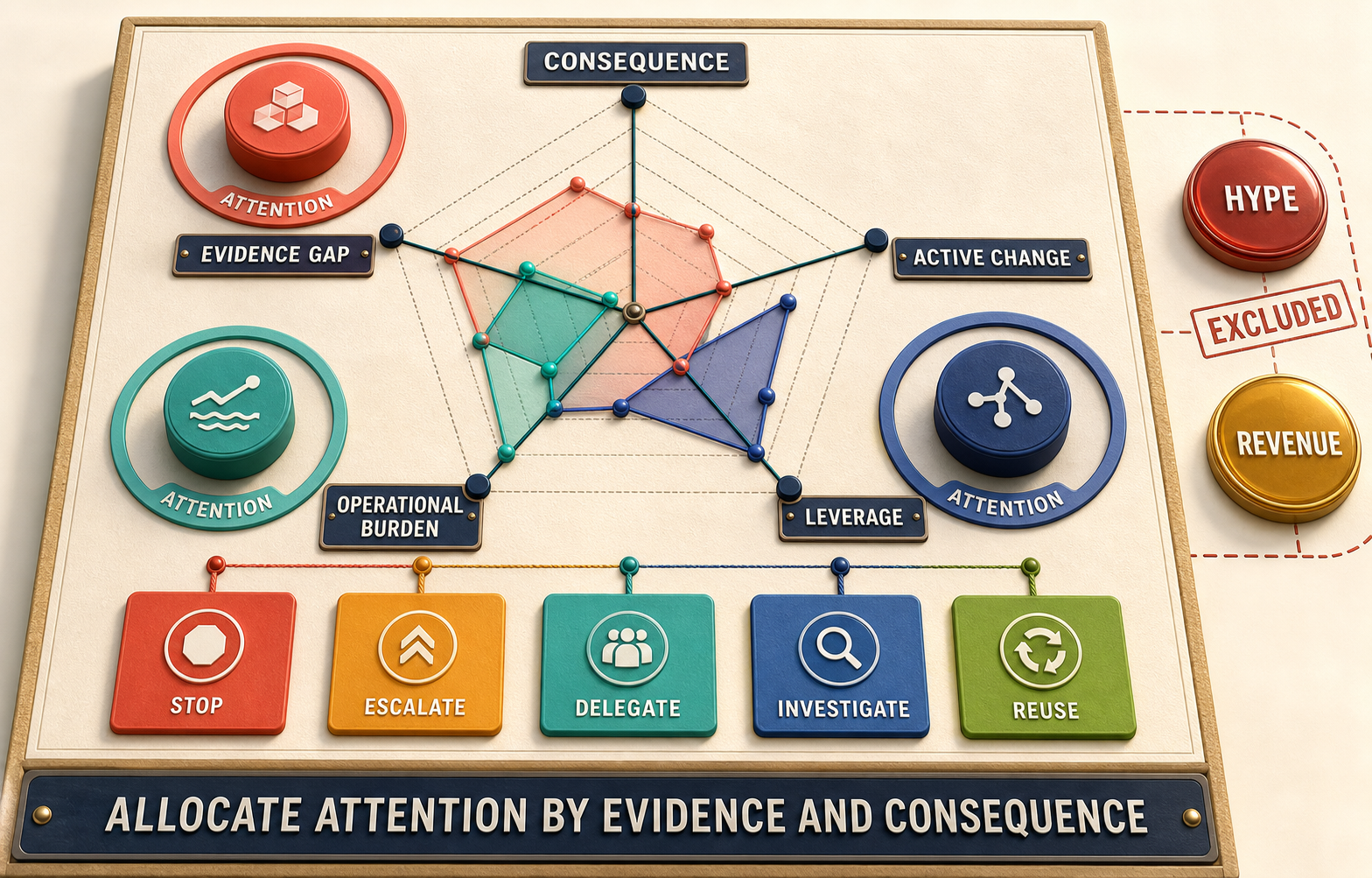
The three profiles are schematic and intentionally unnamed; they do not encode PF-12’s attention order. The portfolio record, evidence packet, and recommendation immediately below establish Sentinel first, Patchwork second, and DraftMate third.
Make the Sentinel stop legible
Sentinel’s known facts are limited:
- consequence is high;
- a critical segment false-negative rate is unknown;
- a threshold change is proposed;
- review queue burden is high;
- no qualified escalation owner is named;
- a fictional two-week deadline exists.
The unknown population error rate is not evidence of safety. The missing owner is not an implementation detail. The recommendation is to stop threshold exposure and escalate the evidence and authority gap.
The Applied AI Engineer can offer:
- deterministic fixtures;
- critical-segment case construction;
- trace and comparison plumbing;
- recovery implementation;
- measurement and review support.
They explicitly decline:
- safety or domain risk acceptance;
- product roadmap priority;
- legal or regulatory judgment;
- privacy/security authority;
- external communication authority.
Governance depends on roles, communication, lifecycle, and review, not a final checklist performed by engineering alone. [CLM-113]
Write an escalation brief that can be decided
A useful escalation brief is short enough to act on and complete enough not to mislead.
Decision needed:
Known facts:
Negative evidence:
Unknowns:
Consequence if wrong:
Current containment:
Recommendation and reason:
Alternatives:
Owner:
Authority required:
Technical work offered:
Authority declined:
Next gate and time boundary:
Sentinel’s brief says:
- decision: whether any threshold exposure can proceed;
- facts: high consequence, missing critical-segment coverage, unowned escalation;
- recommendation: stop and assign qualified domain/safety/product authority;
- next gate: critical cases, recovery owner, and authorized review;
- technical offer: fixture, trace, comparison, recovery;
- declined authority: formal risk acceptance.
Do not dilute the recommendation with pages of architecture. Link evidence by identity.
Keep negative evidence in the main line
Negative evidence is not a footnote. It can include:
- a critical case that fails;
- a segment without coverage;
- evaluator disagreement;
- recovery not rehearsed;
- an effect that cannot be reconciled;
- a provider change that breaks abstention;
- a satellite that rejects a shared seam;
- an owner or authority gap;
- an incident whose hypothesis remains unresolved.
Every recommendation should say how negative evidence changed it. If a portfolio only contains wins, it is a marketing artifact.
Severe failures often require changes to evaluation, process, control, and ownership rather than a narrow model update. [CLM-117]
Assign Patchwork’s migration attention
Patchwork is second, not unimportant.
Recommendation:
- maintain reduced scope;
- fund correction or deterministic fallback evidence;
- preserve the existing behavior contract;
- reuse only validated schema/evaluation/redaction seams;
- keep thresholds, data, and authority local;
- route any candidate exposure through release gates.
Unknown:
- whether a corrected candidate can meet critical behavior and tail envelope before retirement.
Next gate:
- paired candidate correction or deterministic fallback replay.
Authority:
- product, domain, and release authorities decide acceptable scope and residual.
The engineer does not rewrite the contract or accept the residual to meet the date.
Delegate DraftMate without delegating away control
DraftMate has lower consequence, but its effect ledger cannot reconcile an unknown external effect. The decision is delegate-and-restrict-effects.
Delegate:
- local case construction;
- redaction integration;
- state vocabulary mapping;
- deterministic unknown-effect tests;
- recovery evidence;
- weekly evidence updates.
Retain or escalate:
- enabling external effects;
- changing user confirmation;
- privacy purpose or retention;
- accepting unknown recovery;
- product release.
Good delegation specifies outcome, boundary, evidence, authority, check-in, stop condition, and escalation path. It does not merely assign a ticket.
Communicate at six altitudes
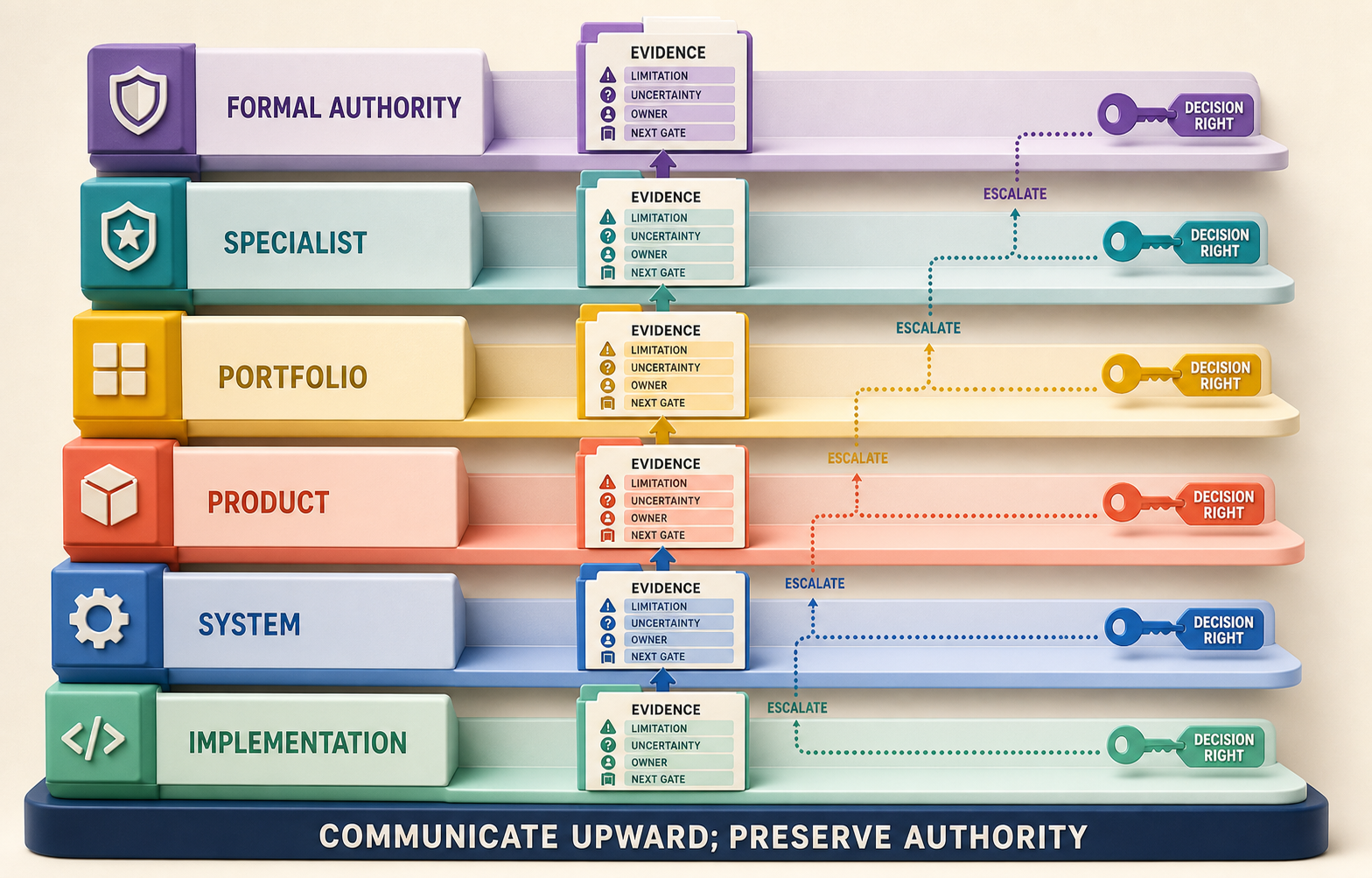
The same evidence must support different decisions without changing facts.
Implementation altitude
Audience: engineers changing code and configuration.
Focus: exact interface, state, test, trace, version, failure, and rollback.
Patchwork message: candidate M03 and M04 cross the frozen response threshold; keep routing disabled and fix candidate calibration or route deterministic fallback.
System altitude
Audience: service and reliability owners.
Focus: end-to-end behavior, components, controls, tails, capacity, recovery, and incident burden.
Patchwork message: candidate improves mean relevance but violates abstention and tail envelopes; change state remains delayed/reduced scope.
Product altitude
Audience: product and domain owners.
Focus: user task, value, consequence, eligible scope, limitations, and decision needed.
Patchwork message: do not broaden answer coverage at the cost of incompatible recommendations; choose reduced capability or a corrected candidate.
Portfolio altitude
Audience: leaders allocating attention and resources.
Focus: cross-system consequence, evidence gaps, active change, operational burden, authority, and leverage.
Message: Sentinel stop/escalation is first; Patchwork migration/fallback second; DraftMate bounded evidence can be delegated.
Specialist altitude
Audience: domain, safety, privacy, security, legal, accessibility, or other qualified reviewers.
Focus: evidence within their remit, unresolved questions, requested judgment, and constraints.
Sentinel message: critical-segment false-negative coverage is unknown; qualified domain/safety review and escalation ownership are required before exposure.
Formal-authority altitude
Audience: the role empowered to approve, reject, or accept a specified residual.
Focus: exact decision, evidence, alternatives, recommendation, residual, and recorded authority.
Message: authorize stop until named gates close, or record a different decision with its accountable owner. Engineering does not imply approval by silence.
Preserve one evidence spine
Altitude is not license to invent a new story. Maintain a shared evidence spine:
- system and version;
- task and population;
- behavior contract;
- evidence IDs and dates;
- observed outcomes;
- negative evidence;
- uncertainty;
- controls and recovery;
- owner and authority;
- decision and expiry.
The implementation view can show case IDs. The portfolio view can summarize two critical regressions. Neither may say the candidate is safe if the evidence says otherwise.
Use links and hashes rather than copying sensitive evidence into every deck. Preserve privacy and access boundaries.
Coordinate governance without claiming it
Security, privacy, risk, and governance frameworks help teams coordinate controls, responsibilities, and evidence. They do not make the Applied AI Engineer the authority for every domain. [CLM-116]
For each specialist question:
- state the decision and scope;
- identify the applicable system behavior;
- provide minimal relevant evidence;
- expose uncertainty and alternatives;
- name implementation options;
- request the specific judgment;
- record the answer and authority;
- translate it into testable system obligations;
- retain expiry and review triggers.
Avoid dumping an entire dossier on a specialist and asking for “approval.”
Separate recommendation, decision, and implementation
These are distinct states:
- recommendation: evidence-backed position from the responsible contributor;
- decision: selection by the accountable authority;
- implementation: technical and operational change;
- verification: evidence that the implementation produced the decided state;
- review: reconsideration under new evidence or expiry.
A recommendation can be rejected. Record why and by whom. An implemented change can fail verification. Roll back. An approved decision can expire when a model, data source, control, population, or consequence changes.
Never write approved when the evidence only shows recommended.
Build an operating cadence around change
PF-12 uses three cadences.
Weekly
- active change and incidents;
- evidence deltas;
- critical negatives;
- next gate;
- blocked owner or authority;
- stop/rollback readiness.
Monthly
- residuals and limitations;
- ownership and operational burden;
- segment and calibration drift;
- control and recovery rehearsal;
- reuse ledger changes;
- expiring decisions;
- portfolio attention order.
Change-triggered
- critical incident;
- provider/model or data change;
- control or evaluator change;
- new user population;
- new shared consumer;
- authority or ownership gap;
- material privacy/security condition;
- retirement or major migration.
Cadence should follow evidence volatility and consequence, not meeting tradition.
Review decisions, not status theater
A decision review asks:
- What changed since the last evidence state?
- Which claim or contract clause is affected?
- What evidence supports and contradicts the recommendation?
- What is unknown?
- What consequence continues while we wait?
- What is contained?
- Which owner and authority are missing?
- What decision is needed now?
- What is the next gate and expiry?
Cancel a review if it has no decision, evidence delta, or learning purpose. Use asynchronous records for ordinary status.
Allocate attention as a bounded resource
Leadership attention, qualified review, evaluation capacity, incident capacity, and organizational change capacity are limited.
When allocating them:
- protect high-consequence unknowns first;
- prevent unbounded exposure;
- fund recovery before expansion;
- distinguish deadline pressure from consequence;
- invest in evidence that can change the decision;
- delegate low-consequence bounded work;
- reuse validated mechanisms, not local authority;
- stop work whose decision cannot be acted on.
Sentinel’s missing authority is itself a resource and governance problem. More model experiments cannot substitute for it.
Make dissent and uncertainty usable
Invite dissent with a structured prompt:
Which fact is wrong?
Which evidence is missing?
Which alternative explanation fits?
Which consequence is understated?
Which control or recovery fails?
Which authority is misassigned?
What observation would change your position?
Record disagreement by claim and evidence, not by seniority. Distinguish:
- factual disagreement;
- interpretation disagreement;
- value or tradeoff disagreement;
- authority disagreement;
- timing disagreement.
The response differs. A factual dispute needs evidence. A value tradeoff needs accountable product/domain authority. An authority dispute needs governance resolution.
Grow other engineers through bounded ownership
Applied AI leadership grows when more people can make strong, evidence-backed decisions without hidden dependence on one expert.
Delegate a bounded decision packet:
- desired outcome;
- behavior contract;
- evidence available;
- exclusions;
- authority held and not held;
- test and review gates;
- stop/rollback conditions;
- communication altitude;
- check-in and escalation.
Mentor by asking:
- What product behavior are you protecting?
- What would disconfirm your hypothesis?
- Which segment or failure is hidden by the average?
- What state is unknown?
- What happens if the dependency fails?
- Who owns the residual?
- Which decision are you making without authority?
Do not solve every ambiguity for the learner. Make the boundary explicit, then let them construct evidence.
Evaluate growth through changed capability
PF-12’s growth plan looks for:
- decisions improved;
- systems bounded;
- negative evidence preserved;
- reusable practice validated;
- others enabled;
- authority engaged correctly;
- incident learning made durable;
- recovery rehearsed;
- unsupported claims rejected.
It rejects title, tenure, headcount, model count, and heroic incident count as sufficient proxies.
Growth can be technical depth, wider system scope, stronger product judgment, better specialist partnership, more reliable operations, or multiplied team capability. It need not mean management.
Balance standardization and local judgment
Standardize what benefits from common structure:
- artifact identity;
- claim and evidence fields;
- state vocabulary mappings;
- change and incident records;
- deterministic test interfaces;
- minimum authority fields;
- expiry and review triggers.
Keep local what depends on task and consequence:
- user behavior contract;
- data permission;
- evaluator validity;
- segments and thresholds;
- control acceptance;
- operational budgets;
- release scope;
- residual acceptance.
Reuse can lower maintenance, but it can also enlarge quality and failure blast radius. Leadership makes the tradeoff visible rather than treating standardization as automatic maturity. [CLM-118]
Complete the final dossier
The Applied AI learning dossier contains:
PF-02: product behavior contract;PF-07: evaluation and judgment artifacts;PF-08: experiment and evidence disposition;PF-09: budgets and observability;PF-10: implemented controls and authority boundaries;PF-11: release and incident evidence;PF-12: change, reuse, and leadership packet.
Completion requires each artifact to be identifiable and internally consistent. It does not create a production claim.
The final verifier checks required artifact IDs and the PF-12 states. It also confirms releaseClaim=none and productionClaim=none. A synthetic complete dossier is complete learning evidence, not deployment authorization.
Use a final decision audit
Before presenting a portfolio recommendation, ask:
Product
- Is the user task and bounded value explicit?
- Is failure consequence visible?
- Is fallback a real product state?
Evidence
- Are claims traceable to evidence?
- Are negative and missing evidence prominent?
- Are metrics segmented and decision-linked?
- Could disconfirmation change the recommendation?
System
- Are data, model, controls, operations, release, and recovery connected?
- Are versions attributable?
- Are unknown states preserved?
Authority
- Are recommendation and decision distinct?
- Is each owner named?
- Are specialist and formal authorities engaged?
- Has engineering declined authority it lacks?
Change
- What invalidates the decision?
- Is expiry defined?
- Can the system stop or roll back?
- Will learning update durable artifacts?
If a section cannot be answered, the honest recommendation may be stop, delay, narrow, or investigate.
Anti-patterns
Executive certainty theater
A clean slide hides unknowns and dissent. Preserve both.
Technical detail as avoidance
Architecture can postpone a product or authority decision. Lead with the decision.
One portfolio score
A number conceals incomparable consequences and evidence quality.
Heroic ownership
One engineer becomes the undocumented control, reviewer, operator, and approver. Build roles and capability.
Escalation dump
Thousands of lines are sent upward without a decision request. Summarize and link evidence.
Authority laundering
An engineer’s recommendation is described as organizational acceptance. Record the actual decider.
Reuse as empire
A shared component expands before consumer evidence, fallback, or economics. Keep the seam narrow.
Incident amnesia
The service recovers but evaluation, controls, runbooks, and ownership remain unchanged. The failure will return in a new form.
What the companion proves
Build each portfolio row from a decision packet
A portfolio row should be a lossless summary of a deeper packet. For Sentinel, the packet contains:
Task: high-consequence classification.
Decision: whether a threshold proposal may enter exposure.
Known: critical segment coverage is missing; review load is high.
Negative: no qualified escalation owner.
Unknown: true false-negative rate and recovery capacity.
Containment: proposed threshold exposure stopped.
Recommendation: stop and escalate.
Owner: classification lead.
Authority: domain, safety, and product roles.
Next gate: qualified owner, critical cases, recovery evidence, formal decision.
Patchwork and DraftMate use the same fields, not the same thresholds or consequences. The shared shape supports comparison while local semantics remain intact.
If the summary cannot link back to evidence, it becomes opinion. If the packet cannot name a decision, it becomes documentation without an action.
Test the attention order with counterfactuals
An ordinal order should survive reasonable challenge.
Ask:
- If Patchwork’s retirement were tomorrow, would it move first? Only if the feature’s unbounded failure consequence or absence of fallback exceeded Sentinel’s continuing high-consequence unknown. Deadline alone is insufficient.
- If Sentinel had a qualified owner and critical coverage passed, would it remain first? Possibly not; the evidence gap would close and attention could shift.
- If DraftMate effects were already visible and irreversible, would its consequence rise? Yes; the state and recovery gap would change.
- If Patchwork fallback capacity failed, would its priority change? Yes; the forced-change recovery option would be weaker.
Counterfactuals expose the reason behind ordering and define monitoring triggers. They also prevent a fixed rank from becoming an unexamined hierarchy.
Choose evidence that can change a decision
Not all measurement deserves equal attention. Before funding an evaluation, ask:
- Which open decision will this evidence inform?
- What result would change the recommendation?
- Is the population relevant?
- Is the evaluator valid for the consequence?
- Can the team act on the result?
- Does the evidence arrive before the decision expires?
- Is the evidence collection itself permissible and bounded?
For Sentinel, more aggregate accuracy may not help. Critical-segment false-negative evidence and recovery ownership can change the stop disposition. For Patchwork, ordinary relevance runs add little; corrected M03/M04 behavior and fallback capacity matter. For DraftMate, another writing-quality score cannot close unknown-effect reconciliation.
Leadership protects teams from measurement activity disconnected from decisions.
Name the cost of waiting
A stop or delay is an active decision with costs:
- lost user value;
- manual review burden;
- deadline compression;
- opportunity cost;
- support complexity;
- degraded fallback experience.
Record those costs next to the protected consequence. This keeps caution honest without allowing schedule or revenue to erase critical gaps.
PF-12 excludes hype and revenue from the attention map because neither is evidence of system readiness or consequence. Product economics can still inform an authorized tradeoff, but they must be presented separately from technical evidence and cannot transform unknown safety into known safety.
Lead a decision review in forty-five minutes
First five minutes: decision and state
State the decision, current containment, recommendation, and authority needed.
Next ten: evidence and negative evidence
Present only evidence that supports or contradicts the decision. Identify versions, population, and freshness.
Next ten: unknowns and alternatives
Name missing evidence, plausible alternatives, and what each protects or sacrifices.
Next ten: owners, recovery, and authority
Confirm implementation owner, specialist reviewers, formal decider, fallback, stop, rollback, and expiry.
Final ten: disposition
Record decision, dissent, conditions, owner, next gate, and communication plan.
If new evidence invalidates the frame, stop the meeting and reopen investigation. Do not force a binary choice because the calendar says the review ends.
Turn a decision into executable work
After an authority chooses, translate the decision into:
- approved scope and exclusions;
- product behavior state;
- exact component/config versions;
- data and control conditions;
- implementation tasks;
- verification cases and signals;
- stop/rollback criteria;
- owner and reviewers;
- release state;
- user/operator communication;
- expiry and next review.
For Sentinel, stop threshold exposure becomes a routing/config assertion and a test that unauthorized states cannot advance. Assign qualified authority remains an organizational gate and cannot be closed by code.
For DraftMate, restrict effects becomes a deterministic control that rejects effect execution until reconciliation tests and formal authority pass.
Verify that the decision became the system state
Implementation completion is not verification.
Verify:
- effective configuration across environments;
- routing and eligibility;
- component/control versions in traces;
- prohibited states and effects;
- monitoring and alerts;
- fallback and recovery;
- user-visible behavior;
- owner acknowledgement;
- decision record link;
- absence of stale cohorts or aliases.
A stop decision that leaves an old cohort active is not implemented. A privacy decision recorded in a document but absent from the trace allowlist is not implemented. A rollback without affected-state reconciliation is incomplete.
Preserve dissent after the decision
A decision record should include:
- dissenting claim;
- supporting evidence;
- response;
- authority making the decision;
- condition that reopens the issue;
- expiry.
Do not rewrite dissent as consensus. Honest records help future investigators understand why a residual was accepted or why a constraint existed.
If an engineer believes a decision exceeds acceptable legal, safety, privacy, security, or professional boundaries, use the applicable escalation and stop channels. A process diagram does not replace those obligations.
Communicate bad news without distortion
Use this sequence:
- decision consequence;
- known facts;
- negative evidence;
- uncertainty;
- current containment;
- recommendation;
- alternatives and costs;
- authority needed;
- next evidence gate.
Example:
Sentinel should not enter threshold exposure. Critical-segment false-negative coverage is unknown and no qualified escalation owner is assigned. Existing aggregate results do not close that gap. Keep the current bounded state, assign domain/safety/product authority, build critical cases and recovery evidence, then reconsider.
This is direct without claiming that harm has occurred or that the true error rate is known.
Communicate favorable evidence with equal discipline
Positive results also need bounds:
Patchwork candidate mean relevance improves on six constructed cases, but two critical abstention cases regress and tail synthetic cost rises. This supports further correction work, not migration.
Avoid phrases such as the new model is better when only one metric improved. State population, comparison, limitations, and decision consequence.
Work with product partners
Product partnership clarifies:
- user task and value;
- eligible population;
- failure consequence;
- fallback experience;
- correction and appeal;
- adoption and comprehension;
- scope tradeoffs;
- roadmap and communication.
Engineering contributes feasibility, system evidence, controls, operations, and recovery. Product authority decides product scope within the organization’s governance. Neither role should force the other to accept hidden residuals.
For Patchwork, the product decision is not which provider? It is which supported behavior can remain available through retirement without violating compatibility.
Work with domain and specialist partners
Prepare reviewable cases, not generic approval requests.
For a domain reviewer:
- show exact task and evidence;
- identify ambiguous or critical cases;
- state evaluator assumptions;
- request judgment on outcome and severity;
- preserve disagreement.
For privacy/security reviewers:
- map data flow, purpose, fields, access, retention, dependencies, threats, controls, residuals, and requested decision;
- separate documented provider properties from locally observed behavior;
- translate decisions into implemented controls and tests.
For accessibility or human-factors review:
- show user states, error/abstention language, timing, correction, and fallback;
- do not infer comprehension from clicks.
The engineer remains responsible for faithful technical translation, not for impersonating specialist authority.
Work with operations and incident partners
Operations evidence includes:
- service and behavior signals;
- tail budgets;
- saturation and dependencies;
- control decisions;
- trace correlation;
- stop/rollback;
- on-call and escalation;
- recovery verification;
- durable learning.
Leadership ensures product behavior appears in operational reviews. A service can be available while the learned behavior fails.
After an incident, ask which portfolio assumptions changed. A new critical failure may reorder attention, invalidate reuse, or require a control and authority review.
Mentor hypothesis and disconfirmation
Use a review template:
Observed symptom:
Hypothesis:
Predicted evidence if true:
Predicted evidence if false:
Discriminating test:
Result:
Alternative explanation:
Decision consequence:
Reward an engineer for disconfirming their preferred explanation. That behavior reduces model-first debugging and premature abstraction.
In Patchwork, the provider adapter makes behavior portable is disconfirmed by critical paired regressions. In reuse, one ranker should serve every product is rejected for lack of independent compatible evidence.
Mentor authority literacy
Ask engineers to label each action:
- investigate;
- recommend;
- implement;
- verify;
- approve;
- accept residual;
- communicate externally.
Then name the role authorized for it. This exposes hidden escalation needs before release.
A junior engineer can own a high-quality evaluation implementation. A senior engineer may still lack authority to approve user exposure. Seniority and decision right are different axes.
Delegate a bounded DraftMate packet
The lead gives the assistant-team engineer:
Outcome: prove unknown-effect reconciliation under disabled effects.
In scope: state capture, idempotency, recovery, redaction, deterministic tests.
Out of scope: enabling external effects, changing confirmation, privacy retention.
Evidence: PF-10/PF-11 patterns and local DraftMate cases.
Stop: any executed external effect or unredacted trace.
Escalate: ambiguous effect identity, missing recovery owner, purpose change.
Review: weekly evidence delta; formal gate before any pilot change.
This packet gives meaningful ownership while preserving product/tool/privacy authority.
Measure whether delegation worked
Look for:
- correct boundary decisions without constant approval;
- early escalation of authority gaps;
- preserved negative evidence;
- deterministic and failure tests;
- clear communication at multiple altitudes;
- recovery evidence;
- documented learning transferred to others.
Do not judge delegation only by speed. A fast implementation that silently enables effects failed the assignment.
Maintain a portfolio evidence log
Append only meaningful deltas:
Observed at:
System/version:
Decision state:
Evidence added/expired:
Negative evidence:
Consequence/containment:
Recommendation change:
Owner/authority change:
Next gate:
At monthly review, remove no historical negatives. Mark them resolved with evidence identity. This makes institutional memory queryable and reduces repeated debates.
Detect portfolio drift
Portfolio decisions drift when:
- a temporary exception becomes permanent;
- an owner leaves;
- a moving model alias changes;
- a fallback stops working;
- a new population enters;
- review queues grow;
- an unknown becomes assumed safe;
- a shared service gains consumers;
- a stop condition loses an alert;
- a decision passes expiry without review.
Use event-triggered checks plus a calendar cadence. Do not wait for an incident to discover that authority or recovery disappeared.
Make reuse a portfolio question
Reuse proposals compete for maintenance and review capacity. Ask:
- Which repeated evidence supports the seam?
- Which consumers gain?
- What local expertise might be lost?
- What blast radius is introduced?
- Who owns operations and deprecation?
- What other reliability work is displaced?
- Can the shared mechanism improve multiple decisions?
- Which negative evidence would stop investment?
PF-12 funds schema/evaluation/redaction learning modestly and rejects the canonical ranker. That balance supports leverage without building an organizational dependency ahead of evidence.
Refuse false precision in roadmaps
Applied AI roadmaps contain uncertainty in provider behavior, data readiness, evaluator validity, control integration, and user response.
Represent work as gates:
- known implementation milestone;
- evidence checkpoint;
- authority decision;
- fallback path;
- stop condition;
- uncertainty range.
Do not promise a launch date as if critical evidence were guaranteed. Provide scenarios:
- if critical replay passes, proceed to shadow;
- if it fails but fallback passes, release reduced capability;
- if both fail, stop the feature.
This is planning, not pessimism.
Review leadership failure modes
Deadline capture
Attention follows the most visible date rather than highest consequence.
Dashboard capture
Available metrics replace important missing evidence.
Authority vacuum
Engineering decides because qualified roles are absent. Escalate and contain instead.
Delegation without boundaries
An owner is assigned but scope, stop, evidence, and authority are unclear.
Review overload
Specialists receive broad packets without a specific question. Prepare scoped review.
Positive-evidence amplification
Favorable averages receive headlines; critical negatives become appendices.
Portfolio platform bias
Shared infrastructure is funded as leverage before independent evidence and ownership.
Heroic recovery
Recurring emergencies are praised while system and process remain unchanged.
Run a quarterly capability review
Ask:
- Which decisions improved because of our evidence?
- Which exposures were narrowed or stopped correctly?
- Which incidents changed durable artifacts?
- Which recovery paths were rehearsed?
- Which assumptions expired?
- Which mechanisms earned reuse?
- Which abstractions were rejected?
- Who can now lead a bounded decision independently?
- Where is authority still missing?
- Which system deserves first attention next?
Attach examples, not self-ratings alone. Growth evidence should show effects on decisions, systems, and people.
Verify the PF-12 leadership packet
The deterministic verifier checks:
- exactly three portfolio systems;
- Sentinel is first attention;
- every recommendation has evidence, uncertainty, owner, authority, and next gate;
- declined responsibility is explicit;
- the evidence standard includes negative evidence;
- six communication altitudes exist;
- all required PF artifact identifiers are present;
- final dossier state is complete synthetic learning evidence;
- release and production claims are
none.
It does not verify that the fictional recommendation is universally correct. It proves the packet retains the fields needed for accountable review.
The final portfolio disposition
1. Sentinel: stop and escalate.
   Reason: high consequence, unknown critical segment, missing qualified owner.

2. Patchwork: delay and reduce scope; fund correction/fallback evidence.
   Reason: forced change plus critical behavior and tail regressions.

3. DraftMate: delegate bounded work; keep effects disabled.
   Reason: lower consequence, specific recovery gap, transferable narrow mechanisms.

Shared claim: none of these states is production approval.
Authority: remains distributed across named product, domain, release, tool,
privacy, security, safety, and other formal roles.
The order can change when evidence changes. The evidence standard and authority boundary should not disappear when it does.
Leadership is visible when the organization can change that order quickly without losing the evidence, recovery, ownership, or formal decision rights behind it. The goal is not a permanent portfolio answer. It is a durable way to reach the next bounded answer together.
Close every review by stating what the team learned, which artifact changed, and who can now act without another meeting. That turns leadership from presentation into operating capability.
Run:
node --test content/publications/applied-ai-engineering/companion/tests/chapter-21.test.mjsThe tests prove the fictional portfolio has exactly three systems, prioritizes Sentinel, keeps recommendations tied to evidence and authority, preserves negative evidence and declined responsibility, includes six communication altitudes, and verifies the required PF artifacts while making no release or production claim.
They do not prove real portfolio priority, organizational authority, legal or policy sufficiency, actual system safety, employment level, business value, or production readiness.
The continuing practice
Applied AI engineering does not end at launch, migration, platformization, or title. Systems change. Providers retire. data drifts. Users discover new failure modes. Controls and organizations evolve.
The durable practice is to keep product behavior explicit, evidence traceable, failures recoverable, change comparable, reuse earned, decisions owned, and uncertainty visible. Lead by improving the quality of the next decision and the capability of the people who must make it.