Lead Beyond One Deployment
Allocate attention across deployments, delegate with authority and evidence, communicate shared facts at multiple altitudes, and grow capability without abandoning engineering depth or inflating authority.
Leading beyond one deployment means increasing the quality and capacity of decisions without becoming distant from evidence. The portfolio record, attention model, delegation contract, multi-altitude memo, and capability-evidence path are original synthesis tools rather than formal standards. [CLM-177]
It does not mean serving the loudest request, creating a colorful numeric heatmap, retaining every escalation, or replacing specialists and customer authorities.
Keep a portfolio record
For each engagement record:
- outcome/guardrail/adoption trajectory;
- current consequence and affected cohort;
- reversibility and blast radius;
- evidence gap/quality/confidence;
- decision latency and deadline context;
- dependency/blocker age and owner;
- readiness/stabilization/ownership state;
- leverage/reuse status;
- next decision, authority, opportunity cost, review trigger.
This keeps portfolio discussion connected to real deployment artifacts. [CLM-184]
Treat the record as a decision interface
A status report describes activity. A portfolio record supports allocation. It must let a reviewer answer: what decision matters next, what is the consequence of delay, what evidence is missing, who has authority, and what receives less attention if this work moves first?
Use a compact record with links to authoritative artifacts rather than copying every engagement document. A useful review row includes:
| Field | Question it answers |
|---|---|
| outcome/guardrail/adoption trajectory | Is the deployment producing bounded value, and for whom? |
| consequence | What becomes harmful, unavailable, irreversible, or expensive if wrong? |
| reversibility | Can exposure or state be safely undone? |
| evidence gap/confidence | Which assumption or decision lacks credible evidence? |
| decision latency | When does waiting remove a safer option or delay valuable learning? |
| dependency age/owner | Is a named external decision blocking the path? |
| readiness/stabilization/ownership | Which lifecycle gate is actually open? |
| leverage state | Is there a bounded product-learning decision, or only local work? |
| next decision/authority | Who must choose what, using which evidence? |
| opportunity cost | Which other review, implementation, or recovery loses capacity? |
| trigger | What event or evidence changes the allocation? |
Keep the row versioned. When consequence or confidence changes, preserve why. Otherwise a portfolio heatmap becomes a memory of colors rather than an auditable decision history.
Avoid averaged engagement health
An engagement can be green on schedule and red on ownership. It can show strong adoption while accessibility evidence is incomplete. It can have stable infrastructure while model quality fails a critical segment. Do not compress these into one health value.
For Orchid, the outcome and adoption trajectory may be bounded-positive, readiness closed, and customer ownership accepted. Product leverage remains deferred pending another context. Those states can coexist. The portfolio record should not turn the deferred reuse proposal into a deployment failure or the successful handoff into proof of platform readiness.
Allocate attention with ordinal judgment
Consider, in order:
- consequence if wrong or delayed;
- evidence gap/uncertainty;
- low reversibility/external state;
- decision latency/time to safe action;
- leverage and opportunity cost.
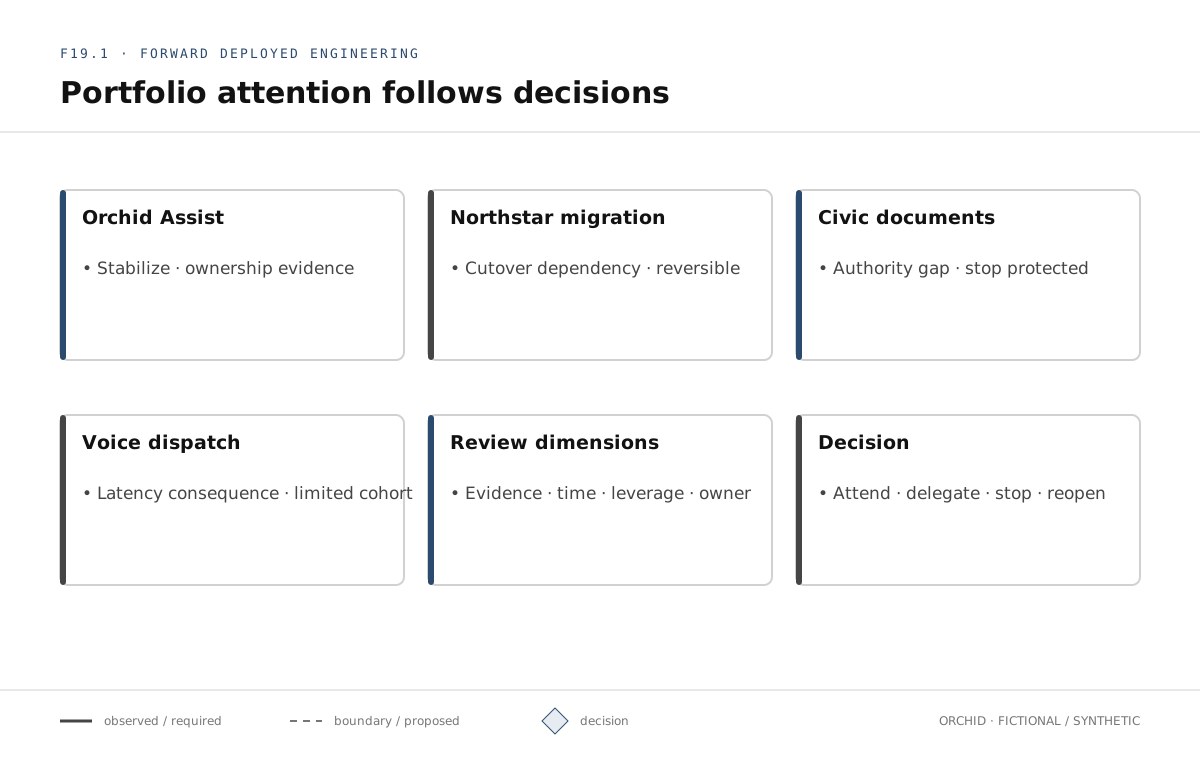
Use low/medium/high/critical as discussion labels with narratives, not measured quantities. The companion sorts ordinally and states that no cardinal risk score exists. [CLM-178]
Make the comparison in a fixed order
When capacity is contested, compare engagements through a repeatable conversation:
- Consequence: Which decision can create or prevent the most serious user, operational, security, safety, data, or business effect within the role’s scope?
- Evidence gap: Where is the current decision most likely to be wrong because a material fact, test, owner, or authority is missing?
- Reversibility: Which path loses a safe option, mutates external state, or expands blast radius soonest?
- Decision latency: Which decision has a closing window, and can a smaller action preserve it?
- Leverage and opportunity cost: Where can bounded attention unlock other owners or reusable capacity, and what is displaced?
The order is not a universal formula. It is a guard against common distortions: revenue loudness replacing consequence, activity replacing decisions, and reuse excitement replacing unresolved production risk.
Write a short rationale after ordering. For example:
Harbor is first because a low-reversibility migration decision occurs before peak load and current restore-access evidence is stale. Civic is second because the active cohort has strong use but unresolved privacy/accessibility authority blocks expansion. Orchid is third because ownership is stable and the next reuse decision can wait for a third context. Pulse remains stopped; attention is limited to preserving lessons and contractual closure.
This explanation can be challenged. A score such as 83 cannot be challenged meaningfully unless its units and model are defensible.
The loudest customer is not necessarily the highest-consequence decision. [CLM-179]
Fictional portfolio exercise
- Orchid: bounded adoption/ownership, reuse proposal deferred; next decision is evidence for a third integration context.
- Harbor migration: critical availability/data state, low reversibility, near decision; highest direct attention.
- Civic documents: strong reported use but incomplete privacy/accessibility guardrails; designated authorities and evidence gap drive hold/escalation.
- Pulse voice: stopped engagement because latency/consent/support constraints cannot meet guardrails; preserve learning, do not rescue sunk cost.
All are constructed examples, not employer/customer outcomes.
Work the four-engagement exercise
Harbor migration. A fictional availability migration has a fixed compatibility window, data state that cannot be trivially rolled back, and stale recovery access. The next decision is whether to proceed, reduce scope, or delay before peak load. The designated release/data authorities own the choice. Direct senior technical attention is warranted because the decision is near, low-reversibility, and evidence-poor.
Civic documents. A constructed public-sector document workflow shows frequent use and improved processing time, but screen-reader task evidence and privacy review for a wider cohort are incomplete. The record separates bounded adoption from guardrail readiness. The correct move is to hold expansion, bring the designated accessibility/privacy owners into the decision, and fund the missing representative evidence. The FDE cannot accept the gaps because the schedule is attractive.
Orchid. The fictional deployment has passed ownership acceptance for its bounded cohort. A proposed intent/reconciliation seam is deferred. The next action belongs mainly to a product owner who must choose a third-context validation. The portfolio leader schedules a review trigger instead of retaining weekly escalation.
Pulse voice. A constructed real-time voice engagement cannot meet latency, consent, and support guardrails within current architecture and staffing. It is stopped. Portfolio discipline means protecting the stop decision from sunk-cost rescue while preserving the evidence, obligations, and reopen conditions.
After ordering these engagements, state which work does not happen. If Harbor receives the portfolio leader’s direct review and a senior engineer for two days, Orchid’s reuse workshop moves to its evidence trigger rather than occupying standing capacity. Opportunity cost is part of an honest allocation. [CLM-187]
Establish an operating cadence
Use different cadences for different decision horizons:
- event-driven: incident, material guardrail failure, irreversible-state decision, authority gap, or recovery trigger;
- daily during exposure/stabilization: consequence, cohorts, evidence freshness, blockers, next decision;
- weekly portfolio review: ordinal attention, dependency age, ownership, staffing, opportunity cost, review triggers;
- monthly learning review: repeated escalations, product packets, reusable playbooks, maintenance burden, stopped work;
- quarterly capability review: system capacity, role coverage, specialist access, mentoring, and growth evidence.
Do not turn every engagement into a meeting at every cadence. The portfolio record should let stable, owned work stay asynchronous until a trigger. Meetings exist for decisions, contested interpretations, and coordination that the record cannot resolve.
For each recurring review define input cutoff, decision owner, required attendees, output record, escalation path, and cancellation rule. A review without a decision or evidence update should be shortened, changed, or removed.
Delegate through a contract
Define:
- objective/outcome and non-goals;
- delegated authority and decisions retained;
- required evidence/artifacts;
- constraints/guardrails/access/data;
- review points and quality bar;
- escalation triggers/path;
- owner and handoff.
Task transfer without authority or escalation produces waiting or unsafe improvisation. [CLM-180]
Delegation is successful when the assignee can make bounded decisions and return evidence, not when the senior person disappears.
Delegate a readiness review without fabricating authority
Suppose a developing FDE will lead the technical readiness review for a fictional internal cohort.
The contract might state:
- objective: assemble the readiness packet, run the review, and recommend go, reduced scope, delay, or stop for the internal cohort;
- authority delegated: request evidence, disposition technical completeness as met/gap, schedule the review, and recommend a cohort;
- authority retained: release owner signs exposure; security/privacy/safety authorities decide formal exceptions; portfolio lead changes staffing;
- required evidence: current artifact/evidence hashes, critical-segment results, recovery rehearsal, support/command plan, limitations, and decision record;
- constraints: synthetic or approved data only, no production expansion, no unrecorded exception, no bypass of critical failure;
- review points: packet outline, pre-read, decision review, and post-decision handoff;
- escalation: unresolved authority, material gap, evidence conflict, or deadline pressure goes to the named owner immediately;
- quality bar: another reviewer can trace every recommendation to current evidence and see the consequence of each gap.
If the assignee must ask the portfolio leader before every ordinary evidence request, authority is too narrow. If the assignee can approve a customer risk exception, authority is too broad. Good delegation defines the useful middle.
Review without taking the work back
At a review point, ask the assignee to show the decision, evidence, uncertainty, alternatives, and next trigger. Correct a dangerous boundary or unsupported conclusion directly. For less consequential differences, prefer questions and explicit acceptance criteria over rewriting the packet yourself.
When the same quality gap appears repeatedly, improve the system: a template, example, test, reviewer checklist, mentoring exercise, or clearer authority map. Permanent senior rework is a capacity failure disguised as quality control.
Communicate at multiple altitudes
Preserve shared facts, uncertainty, decision, authority, consequence, and review trigger.
Executive
Outcome/guardrail, material consequence, options/tradeoff, decision/owner, opportunity cost, next trigger.
Operational
Cohort, support/command, signals/gates, staffing/access, recovery, schedule/cadence.
Technical
Architecture/state, evidence, failure hypotheses, compatibility, controls/tests, correction/recovery.
Detail changes; truth does not. [CLM-181]
Write the same escalation three ways
Shared facts:
- customer recovery access has not been executed under the identity dependency failure;
- the planned wider cohort begins in 48 hours;
- current non-safety internal exposure is stable;
- release authority owns widen/hold; security owns emergency-access conditions;
- review trigger is an executed recovery test with current access and evidence.
Executive version
Recommend holding wider exposure. The current internal cohort is stable, but the recovery path for the wider cohort depends on access that has not been executed under the failure it must survive. Widening now exchanges schedule for an unbounded recovery gap. Release authority decides after the security-owned access conditions and recovery test are complete.
Operational version
Maintain the internal cohort and current support schedule. Do not widen. Operations will run the recovery scenario at 10:00 with security and the release owner present, record access/action/timing/integrity evidence, and post a disposition by 13:00. If access remains unavailable, use the Chapter 15 delay path and notify affected stakeholders.
Technical version
Artifact/config/schema are unchanged and current cohort signals are within the stated window. The recovery rehearsal is incomplete because the emergency principal has not been authenticated while the normal identity dependency is unavailable. Execute the scoped access path, force the representative partial-state condition, roll forward or isolate according to the state tree, verify user-visible and integrity state, and bind evidence to the release record.
The versions differ in action detail, not facts or certainty. None invents an ETA for technical success.
Example shared fact: customer recovery access is unexecuted. Executive: hold expansion. Operational: maintain reduced cohort/support. Technical: execute identity-dependency recovery test. Same fact, different action detail.
Convert permanent escalation into capacity
If the same escalation recurs, create:
- clearer decision right/control;
- reusable product capability;
- tested playbook/runbook;
- staffed specialist/owner;
- better interface/evidence;
- formally accepted residual gap.
Heroic coordination is not a durable operating model. [CLM-186]
Convert an escalation through a capacity ladder
Classify why the escalation repeats:
- unclear decision right;
- missing evidence or signal;
- fragile interface or product gap;
- absent specialist capacity;
- under-specified runbook/playbook;
- ownership or access dependency;
- capability gap in the delivery team;
- genuinely exceptional high-consequence judgment.
Then choose a response:
- clarify the decision record and authority;
- automate or instrument evidence collection;
- build a bounded product/control/interface improvement;
- create and rehearse a playbook;
- staff or schedule the required specialist;
- train through supervised evidence-bearing work;
- accept an explicit residual dependency with owner and expiry;
- retain senior review only for the truly exceptional decision.
Measure whether the change reduces waiting, unsafe improvisation, repeated rework, or hidden dependency. Merely routing the same escalation through a new channel is not system capacity.
Staff around decisions and boundaries
Do not staff only by component backlog. Map the upcoming decisions and the expertise/authority they require.
A bounded deployment may need a strong integrator as its day-to-day owner, a part-time security specialist at threat/control and readiness gates, an accessibility reviewer before representative UAT, and a senior production engineer during migration/recovery. Keeping all specialists embedded full time can be wasteful; bringing them after an irreversible decision can be dangerous.
Record the engagement owner, specialist triggers, backup owner, review capacity, and escalation availability. If no qualified owner can be present before a critical decision, reduce scope or delay. Schedule pressure does not create expertise.
Preserve engineering depth
Portfolio leaders still need enough code, architecture, data, security, reliability, and workflow depth to review evidence, find hidden failure, challenge abstraction, and delegate responsibly. [CLM-185]
Direct work shifts toward the highest-leverage/highest-uncertainty seams; it does not vanish.
Maintain a technical evidence habit
Portfolio-level depth can be preserved through deliberate contact with consequential artifacts:
- review one failure trace and recovery record, not only a dashboard summary;
- inspect a contract or state transition at the integration seam;
- run a representative companion or rehearsal path;
- challenge a critical-segment evaluation result;
- read a migration or corrective-action diff;
- join a bounded user or operator observation;
- rotate deep reviews across engagements rather than hovering over all code.
The goal is not to out-code every owner. It is to remain capable of detecting when an abstraction hides state, evidence, authority, or failure consequence. [CLM-185]
Set a rule for direct intervention. Enter the code or incident path when consequence, evidence gap, uncertainty, or missing capability justifies it. State the objective and exit. If the leader becomes the permanent implementer, the portfolio has not gained capacity.
Grow through capability evidence
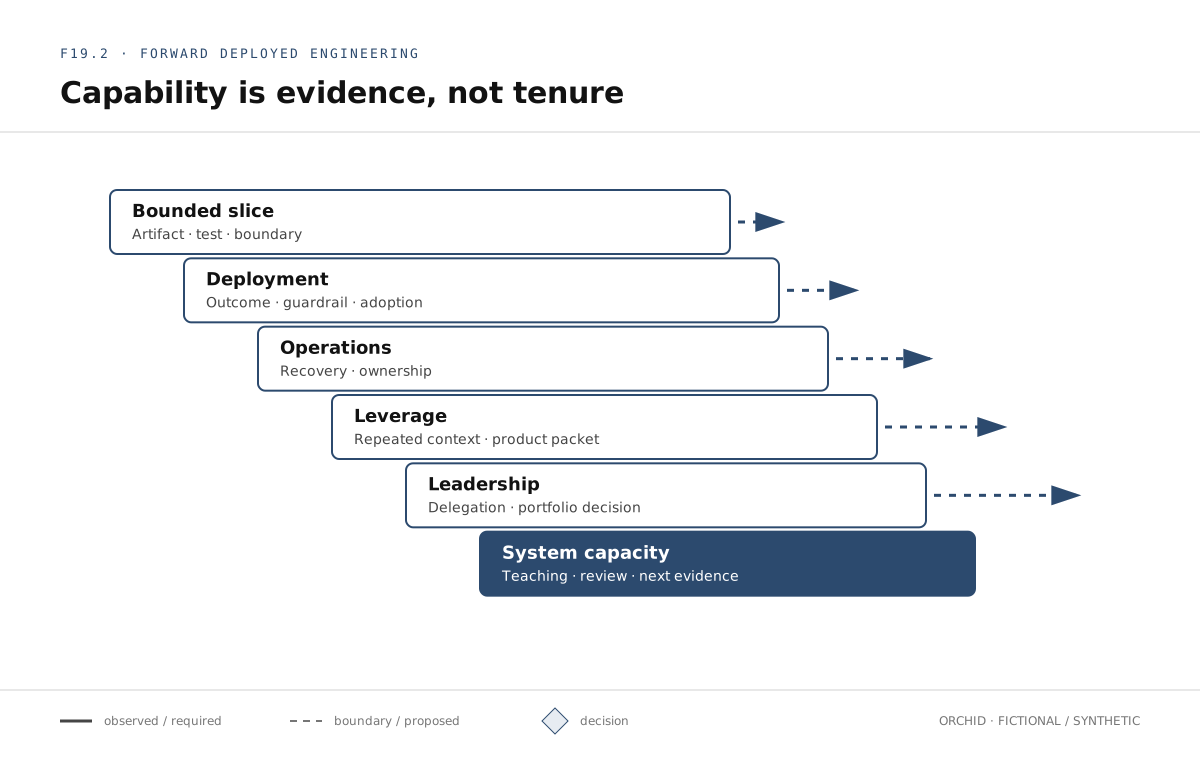
Build a six-month growth plan across:
- deeper production implementation/diagnosis;
- stronger workflow/outcome discovery;
- security/privacy/safety boundary judgment;
- verification/AI evaluation/recovery;
- stakeholder decisions and writing;
- adoption/ownership;
- reuse/product learning;
- delegation/portfolio review.
For each: target capability, current evidence, stretch task, mentor/reviewer, artifact, pass criteria, boundary/escalation, review date.
Growth is evidence, not tenure/title/travel/burnout. [CLM-183]
Seniority increases decision-quality responsibility, not adjacent authority. [CLM-182]
Build a six-month evidence plan
An example plan for an FDE moving from bounded-slice ownership toward end-to-end deployment leadership:
Months 1-2: diagnosis and contracts. Lead discovery for one unfamiliar workflow, produce an evidence log/state model, and review an interface contract with a senior engineer. Pass when users validate exceptions and contract tests cover unknown completion. Escalate domain and data authority rather than self-approving semantics.
Months 2-3: verification and recovery. Own the verification matrix and run a partial-state recovery rehearsal. Produce evidence/limitations and a decision record. Pass when a reviewer can reproduce the failure and recovery without the FDE narrating hidden steps.
Months 3-4: readiness and communication. Lead a bounded readiness review under a delegation contract. Write executive and technical versions of one material gap. Pass when the designated authority can choose among real alternatives and the evidence survives challenge.
Months 4-5: ownership transfer. Supervise customer operators performing release, recovery, support, and decision tasks. Pass when assistance is recorded, access is transferred, and hidden FDE dependency is removed or explicitly excepted.
Months 5-6: leverage and teaching. Produce a pattern ledger entry with negative cases and review another engineer’s deployment packet. Pass when the reuse disposition states invariant, variance, isolation, cost, owner, validation, and disconfirmation.
The dates do not guarantee promotion. They create inspectable evidence for the next capability decision. Travel volume, long hours, customer visibility, and title are not substitutes. [CLM-183]
Close the dossier
The companion dossier index requires:
- source hash and build hash;
- GitHub issue/phase state;
- open risk/exception state;
- reuse proposal/defer/reject state;
- current limitations;
- customer/product/operations next owners.
This makes closure resumable/auditable. [CLM-188]
Review closure as if the original FDE disappears
Ask a reviewer who did not lead the engagement to locate:
- the canonical source and build identified by hashes;
- the final scope, cohort, outcomes, guardrails, adoption, and limitations;
- current issue/phase state;
- open risks/exceptions and designated owners;
- access and ownership acceptance;
- reuse proposal/defer/reject records;
- product/customer/operations next decisions;
- the trigger for any future review.
If the reviewer must rely on a private message, an individual’s memory, or unexplained local files, the dossier is not closed. Closure does not require that every risk disappear. It requires that remaining state be visible, owned, bounded, and resumable.
Failure modes and repairs
Loudness becomes priority
Repair: compare consequence, evidence gap, reversibility, and decision latency; record opportunity cost and rationale. [CLM-179]
The heatmap becomes arithmetic truth
Repair: use ordinal labels plus narrative evidence and confidence. Never sum incomparable categories merely to rank them.
Delegation is task forwarding
Repair: define bounded authority, evidence, constraints, review points, escalation, and owner. Test whether the assignee can act without unsafe improvisation. [CLM-180]
The leader keeps every escalation
Repair: classify the recurring cause and create a control, capability, playbook, owner, or explicit residual dependency.
Executive communication removes uncertainty
Repair: reduce detail but preserve the uncertainty, authority, consequence, and review trigger.
Strategy loses technical contact
Repair: maintain rotating deep evidence reviews and enter direct work at the highest-consequence uncertain seams with an exit condition.
Growth rewards burnout
Repair: evaluate artifacts, decisions, outcomes, boundary judgment, teaching, and progressively harder scope. Do not treat travel, availability, or exhaustion as competence.
Seniority expands authority by implication
Repair: preserve the same legal, security, privacy, safety, audit, accessibility, and risk-decision boundaries. Seniority improves the quality and timing of escalation; it does not erase it.
Conduct the chapter exercise
Build four complete portfolio records from the fictional cases. Order them, then write the rationale and displaced work. For the highest-priority engagement:
- define the next decision and designated authority;
- write a delegation contract for a bounded workstream;
- write executive and technical versions of one escalation;
- choose an event/daily/weekly/monthly review cadence;
- convert one recurring escalation into system capacity;
- identify what direct technical evidence the portfolio leader will inspect;
- define the review trigger that changes the allocation.
Finally, create a six-month capability plan with artifacts and pass criteria. A peer should be able to challenge every allocation using the recorded evidence, not inferred status or title.
Run the weekly portfolio decision review
Send current records before the meeting. Review only changes, contested evidence, aging dependencies, and decisions. A practical agenda is:
- incidents or irreversible-state decisions that changed consequence;
- material evidence gaps and authority deadlines;
- readiness/stabilization/ownership gates needing disposition;
- dependency age and escalation path;
- staffing/delegation changes and specialist triggers;
- product-leverage proposals at their review trigger;
- stopped/deferred work and opportunity cost;
- next decisions, owners, and event-driven review triggers.
Record the before/after allocation and why. If every engagement stays high priority, the review has avoided its job.
Protect stopped work from silent restart
A stopped engagement needs a closure state: reason/evidence, consequence, obligations, preserved artifacts, access/data cleanup, owner, reopen conditions, and displaced capacity. New enthusiasm or a senior request cannot silently restart it. Reopen through a new decision using the changed evidence.
For fictional Pulse voice, the reopen trigger might require a consent design owned by the correct authority, an architecture that meets the stated latency under representative conditions, and a staffed support model. Until then, experiments remain bounded or closed.
Adapt leadership to team maturity
In a founding-FDE setting, one leader may hold several engagement records and write code directly. The operating model should still expose which decision is being neglected and where missing specialist authority requires reduced scope. Small team is not permission to absorb every role.
In a mature multi-role team, delegation and specialist coverage can increase, but status layers can distance leaders from evidence. Rotate deep technical reviews, require shared-fact memos, and keep the next decision/authority visible. More process should reduce ambiguity and dependency, not merely multiply reporting.
Leadership maturity is measured by better decisions and greater system capacity: fewer hidden escalations, clearer ownership, faster safe evidence, and more people able to act within boundaries. It is not the number of meetings or people reporting to the portfolio lead.
Complete OA-11
Add portfolio review, two-altitude escalation, operating cadence, staffing/delegation contract, opportunity cost, review triggers, and capability growth plan.
Opportunity cost and consequence of delayed attention remain explicit. [CLM-187]
The Chapter 19 gate
- portfolio records preserve outcomes/guardrails/adoption/evidence/owners;
- attention is ordinal/explainable, not false arithmetic;
- loudness/seniority do not replace consequence;
- delegation has authority/evidence/review/escalation;
- multi-altitude messages share facts/uncertainty;
- recurring escalations become system capacity;
- growth is artifact/evidence based;
- adjacent authority remains bounded;
- dossier hashes/state/next owners exist;
- companion portfolio tests pass.
The FDE lifecycle closes where it began: accountable for a deployed outcome, rigorous about evidence, and honest about authority. The difference is leverage - more people and systems can now make better decisions without depending on one person.