Make the Solution Usable and Ownable
Diagnose adoption friction without user blame and prove customer capability across use, operation, support, release, recovery, access, decisions, and change ownership.
A deployed system is not successful if users must work around it or if only the FDE can operate it.
Usability asks whether representative people can complete the real workflow. Ownership asks whether the customer can observe, support, release, recover, decide, and change the system without hidden FDE dependency.
Documents support both. They prove neither. [CLM-158]
Diagnose adoption friction without blame
Use ten categories:
- capability: the function cannot perform the needed task;
- workflow fit: sequence/handoff/exception conflicts with work;
- trust/evidence: users cannot verify provenance, uncertainty, or consequence;
- access: identity, qualification, device, network, or permission blocks;
- performance: latency/reliability/connectivity makes use impractical;
- incentive: local costs/metrics/authority discourage the intended path;
- policy: required procedure/approval conflicts or is unclear;
- accessibility: interaction excludes users/assistive contexts;
- support: help/escalation/recovery is unavailable;
- knowledge: users/operators lack correct mental model or practice.
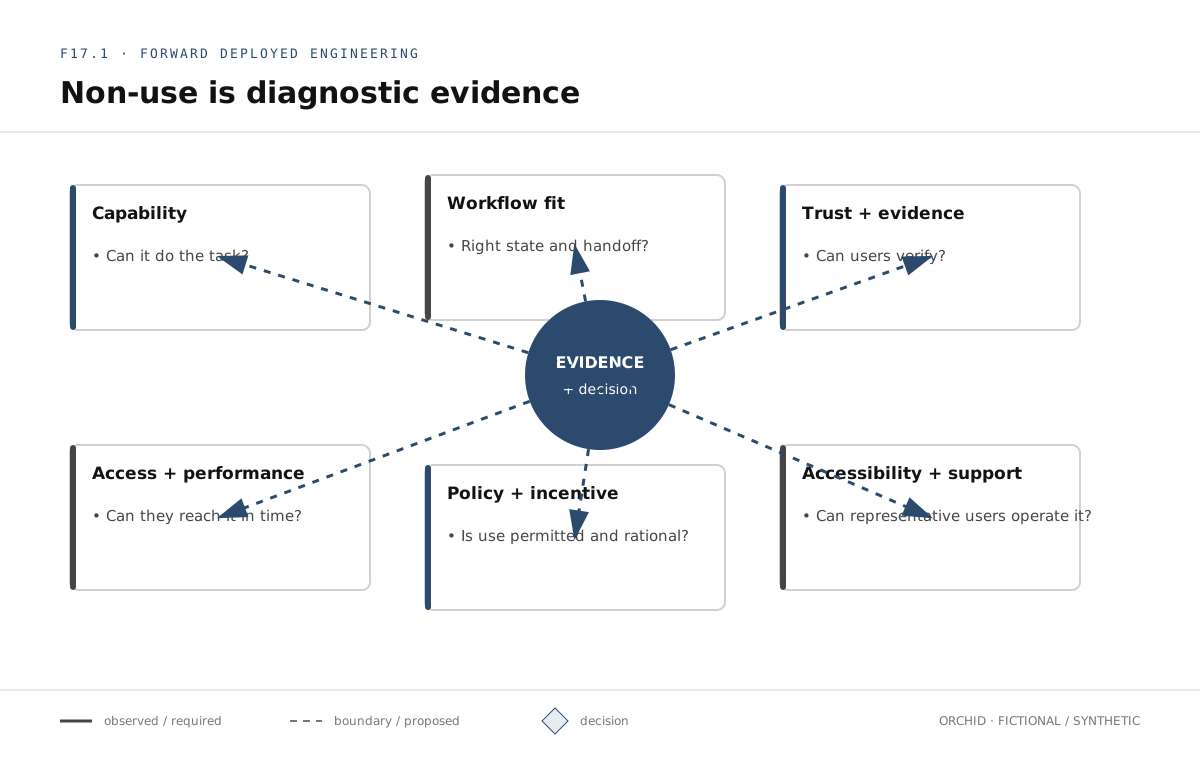
The companion requires evidence, a next test, and owner for each diagnosis and marks userBlame: false. This taxonomy is original synthesis. [CLM-153] [CLM-154]
Turn a non-use signal into a testable diagnosis
Start with observed behavior, not an attitude label.
Weak entry: Technicians resist the new workflow.
Evidence-bearing entry:
In 8 of 12 observed pump-family tasks, technicians opened the suggestion but returned to manual search before approval. The interface does not show source version or the evidence passage beside the proposed action. Hypothesis: trust/evidence friction. Next test: show evidence-first review to the same role across representative clear, ambiguous, and missing-evidence tasks. Owner: product workflow owner. Alternative hypotheses: latency, equipment-match confidence, policy, or incentive.
The second entry can be disproved. If bypass remains after evidence visibility improves, inspect the alternatives. Perhaps the suggestion arrives after the technician has completed manual search, or supervisors measure another completion path. The taxonomy routes evidence; it does not diagnose personality.
Keep a friction record with signal, cohort/task, candidate categories, evidence, confidence, next discriminating test, owner, repair, observation window, and outcome/guardrail effect. Close rejected hypotheses rather than leaving every possible cause open.
Five non-use patterns imply different tests:
- Never starts: verify eligibility, access, device/network, awareness, and whether the workflow trigger exists.
- Starts then abandons: inspect latency, state clarity, evidence, accessibility, error recovery, and time pressure.
- Completes but bypasses later: inspect trust, result quality, downstream handoff, incentives, and support burden.
- High use with weak outcome: inspect coerced use, wrong task, gaming, rework, guardrail harm, and attribution.
- Works for one segment only: inspect role, site, language, assistive technology, connectivity, data quality, equipment family, and consequence.
Triangulate adoption evidence
Do not use one metric:
- eligible use and repeat use;
- task completion/time/error/rework/fallback;
- outcome/guardrail movement with attribution limits;
- support demand/reason/resolution;
- satisfaction/trust/evidence inspection;
- dropout/abandonment/manual bypass;
- role/site/region/accessibility/connectivity/risk segments;
- qualitative observation/interview.
Login or usage can be coerced by policy. Satisfaction excludes people who left. Low support can mean ease or inaccessible support. Outcome can change for unrelated reasons. Signals are complementary. [CLM-155]
Build an adoption evidence table
For each target cohort, put signals beside the claims they can and cannot support:
| Signal | Can support | Cannot establish alone |
|---|---|---|
| eligible/repeat use | exposure and repeated interaction | correct use, outcome, voluntariness |
| task completion/error/time | workflow performance under observed conditions | sustained outcome or every segment |
| fallback/bypass/dropout | friction location and recovery behavior | cause without another test |
| support reason/resolution | operating burden and recurring defects | absence of unreported friction |
| evidence inspection/approval | review behavior and control use | correctness of the underlying suggestion |
| satisfaction/trust report | perceived usefulness/confidence | behavior, accessibility, or outcome |
| outcome/guardrail movement | bounded operational change | attribution to one feature or transferability |
Segment the table and record missingness. If users who abandon the workflow also stop answering surveys, a favorable satisfaction average is selected evidence. If telemetry excludes offline completion, low use may be a measurement boundary rather than rejection.
Support demand deserves special care. Rising tickets can mean worsening quality, wider legitimate adoption, improved reporting, or a newly visible limitation. Classify reasons and connect them to releases, cohorts, and resolution evidence. [CLM-161]
Observe the whole task
For Orchid, observe a representative technician:
- receive/open ticket;
- confirm equipment or resolve ambiguity;
- inspect evidence/source/version;
- distinguish verified fact from suggestion;
- handle missing evidence/fallback/reconciliation;
- route qualified approval;
- complete non-digital inspection/handoff;
- record decision and find support.
Whole-journey evidence includes non-digital steps, workarounds, exceptions, and support. [CLM-162]
The injected bypass has a specific cause: recommendations omit visible supporting evidence. Classify trust-evidence, test an evidence-first review design, and observe task behavior. Do not send generic retraining first.
Run a whole-task observation
Prepare representative scenarios, roles, devices, connectivity, permissions, and exceptions. Ask the participant to work as normal. Avoid coaching unless safety or the protocol requires it; record every intervention.
Capture the task trigger, prior context, equipment/data state, evidence inspected, decisions, hesitation, backtracking, workarounds, non-digital actions, handoffs, error/fallback/recovery, completion, time, correctness, assistance, accessibility context, and what the user expected next.
Afterward, ask why at specific moments without treating the explanation as complete truth. Combine observation, artifact state, telemetry, and interview evidence.
For Orchid, a successful click path still fails if the technician carries the wrong part because inventory was stale, or if a qualified approver cannot reconstruct the evidence. The unit is the operational task, not the screen. [CLM-162]
Use training for knowledge, not design debt
Training is appropriate when the workflow/design/control is sound and the remaining gap is knowledge/practice. It should contain role-specific tasks, examples/exceptions, safety/authority boundaries, fallback/support, and verification.
Do not train around missing access, misleading state, slow performance, inaccessible UI, invisible evidence, bad policy, or absent support. [CLM-156]
Verify learning through consequential work. Technicians should identify evidence, uncertainty, fallback, and escalation. Qualified reviewers should distinguish a suggestion from an approved decision. Support should diagnose a cohort without exposing payloads. Operators should release, hold, recover, and reconcile. Decision owners should locate current limitations and exceptions.
Evidence is a completed task, accurate explanation, correct escalation, or successful rehearsal, not attendance. If a person succeeds only while the FDE prompts each step, record assisted performance and retest after repair.
Combine accessibility criteria and task evidence
Apply relevant WCAG 2.2 criteria with keyboard/focus/semantics/zoom/reflow/error/assistive-technology checks. Then observe representative users performing consequential tasks.
Conformance evidence does not alone prove usability for every context. [CLM-157]
Accessibility work has two linked layers. Criteria-based checks find barriers in semantics, keyboard path, focus, contrast, reflow, error identification, labels, status messages, and assistive-technology compatibility. Representative task observation tests whether the complete workflow works in its intended context, including time pressure, evidence comparison, offline behavior, and support.
Do not claim accessible from an automated scan. Record criteria/version/scope, methods, tools, manual results, assistive contexts, defects, owners, retests, and limitations. Designated accessibility expertise owns formal interpretations where required; the FDE integrates evidence and repairs into delivery.
Build the ownership acceptance model
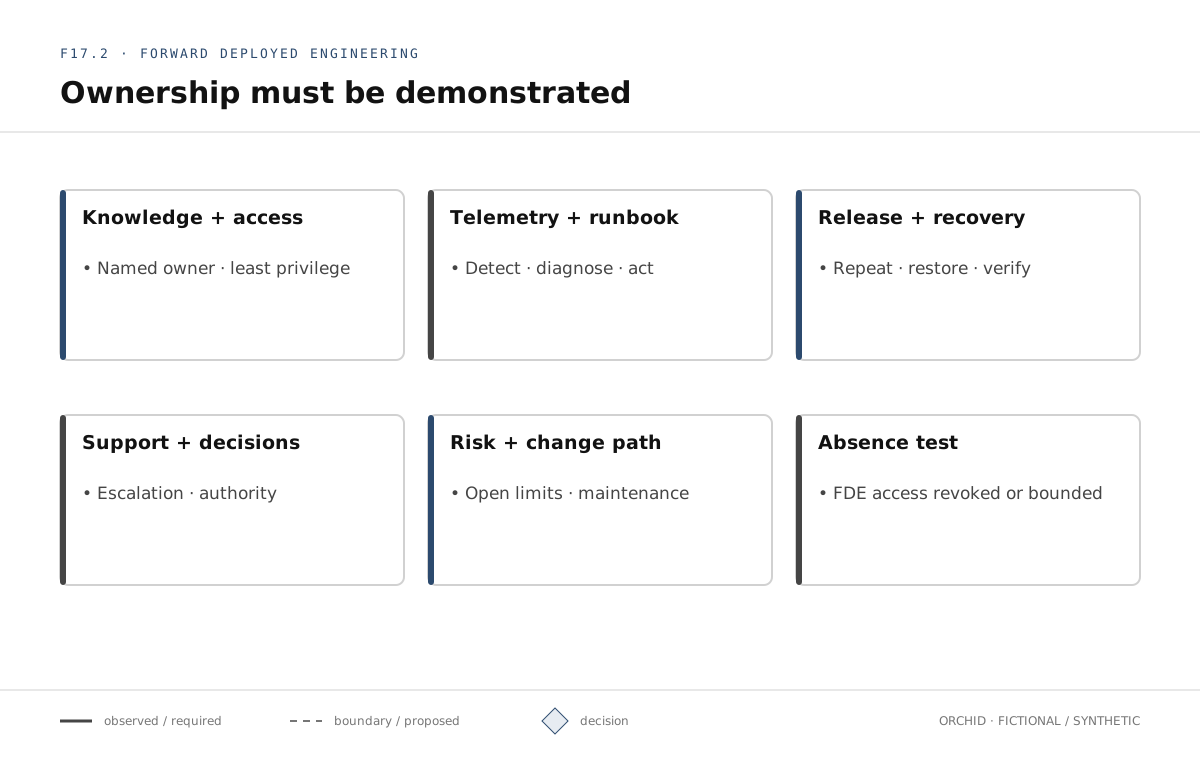
For each area require owner plus demonstrated evidence:
- knowledge: explain system/workflow/limitations;
- access: reach required systems under least privilege;
- telemetry: diagnose injected symptom/cohort;
- runbook: execute/escalate and improve steps;
- release: prepare/evidence-gate/hold a release;
- recovery: choose/execute/verify a recovery;
- support: triage/user communication/escalation;
- decisions: identify authority and record disposition;
- open risk: understand exceptions/expiry/residual support;
- change path: safely modify/test/release and feed product learning.
Ownership is demonstrated capability, not delivery of a folder or RACI. [CLM-159] [CLM-164]
Define acceptance evidence precisely
For each area, write a scenario and observable pass condition. Has runbook is weak. Customer operator detects an injected low-connectivity degradation, locates the current runbook, chooses the correct cohort hold, and records escalation without FDE intervention is testable.
Evidence can be pass, assisted, failed, not run, or exception. Assisted records what the FDE did because it identifies the remaining dependency. A signed document cannot overwrite a failed demonstration.
Use more than one operator for high-consequence areas. One expert’s success can hide a single-person dependency. Test backup access, off-hours escalation, and the failed dependency where relevant. Keep evidence synthetic or appropriately governed; ownership testing does not justify unsafe production experiments.
Run supervised acceptance
Customer operators, not the FDE, perform:
- identify a degraded cohort from signals;
- inspect a correlated trace without sensitive payload;
- hold/disable a feature cohort;
- reconcile an unknown intent;
- execute a synthetic release and partial-migration recovery;
- restore/verify from approved evidence;
- handle support/escalation;
- record a decision/open risk.
The FDE observes and records assistance. If intervention is necessary, ownership is not yet demonstrated for that area.
Run the Orchid acceptance session
Begin with the current bounded scope and limitations. Name customer decision authority and the FDE’s observer/support role. Then execute a sequence:
- A technician encounters an ambiguous equipment match and uses the stop/fallback path.
- A qualified reviewer inspects source/version and rejects a suggestion lacking evidence.
- Support identifies a degraded low-connectivity cohort without reading sensitive payloads.
- Operations holds that cohort, uses the runbook, and communicates through the named channel.
- Release owner reviews the packet and declines a release with a critical gap.
- Operators run the partial-migration rehearsal, choose roll-forward from actual state, and verify recovery.
- A customer owner records an expiring open-risk exception within delegated authority.
- The team locates the change path, tests a bounded correction, and names product-learning ownership.
Record who acted, access used, evidence, assistance, result, gap, owner, and retest. Do not convert a synthetic rehearsal into a production recovery claim.
Transfer and revoke access
Inventory human/workload/support/emergency permissions. Ensure customer owners have required release/recover/support access, test it, and remove FDE privileges.
The companion blocks transfer when customer permission is missing or the FDE retains a required privileged permission. [CLM-160]
Access transfer is a state transition, not an email request. Inventory accounts, roles, groups, tokens, workload identities, emergency credentials, support paths, local devices, and third-party consoles. For each, record purpose, owner, scope, environment, expiry, last use, approval, test evidence, and revocation state.
Test customer access before removing the last working FDE path, but do not leave both paths indefinitely. Sequence transfer, demonstration, rollback for the access change itself, revocation, verification, and audit review. Rotate or invalidate shared material rather than assuming removal from a group eliminates copied credentials.
If support access continues, define ticket/incident trigger, approved actor, time bound, permitted actions, customer visibility, audit, and removal. The customer must retain an operating path that does not depend on the FDE being available.
Continuing support access must be explicit, purpose/time/scope bounded, approved, audited, revocable, and not the only operating path.
Make handoff exceptions explicit
If the customer cannot yet own an area, record:
- missing capability/evidence and consequence;
- interim owner/support service;
- exact FDE/vendor dependency;
- access/control/monitoring;
- authority and accepted residual risk;
- delivery/retest date;
- expiry/escalation/exit.
Do not disappear or stay forever. [CLM-163]
An exception is acceptable only when the residual dependency is visible and governed. For example:
Recovery key rotation remains assisted for 14 days because the backup operator has not completed the failed-identity exercise. Customer security owns the exception; the FDE may observe but not approve emergency use. Scope is the internal cohort. Monitoring is the access audit plus recovery readiness check. Retest is 30 August. If it fails or the cohort changes, exposure remains held. FDE privileged access expires after the successful retest or on 31 August, whichever comes first.
This is different from FDE will help as needed. It states consequence, scope, authority, evidence, and exit.
Failure modes and repairs
Logins become adoption
Repair: combine whole-task completion, outcome/guardrail, support, dropout, satisfaction, and segments; preserve attribution limits.
Users are blamed for bypass
Repair: describe observed behavior, use the friction taxonomy, run the next discriminating test, and give the repair an owner. [CLM-154]
Training conceals product debt
Repair: use training only for verified knowledge gaps; repair workflow, access, evidence, performance, policy, accessibility, or support defects in the system. [CLM-156]
Accessibility is an automated score
Repair: combine versioned criteria/manual/assistive checks with representative end-to-end task evidence. [CLM-157]
Handoff is a document transfer
Repair: require customer demonstrations for release, recovery, support, decisions, access, and change. Record assistance. [CLM-158]
The FDE remains the hidden operator
Repair: test customer paths, revoke privilege, and formalize residual support with expiry and exit. [CLM-160] [CLM-163]
Exit happens while customer readiness is unresolved
Repair: choose explicit delay, reduced scope, supported exception, or disengagement. Preserve the owner and consequence; do not silently disappear.
Conduct the chapter exercise
Given five fictional non-use signals, classify likely friction categories but select only the next discriminating test, not a final diagnosis. Then run a ten-area ownership acceptance tabletop with at least one failed and one assisted result.
Produce a segmented adoption evidence table, whole-task observation record, friction hypotheses/tests/repairs, role-specific enablement evidence, accessibility record, ten-area results, access transfer/revocation inventory, and explicit exception or final acceptance.
Pass when representative users can complete the task, customer operators demonstrate consequential operating work, all assistance is visible, and the designated authority accepts the bounded state.
Turn diagnosis into a repair experiment
A friction hypothesis is useful only if it changes the system or the next evidence.
For each hypothesis record:
- observed behavior and affected segment;
- candidate category and confidence;
- alternative explanations;
- smallest ethical/representative test;
- repair owner and authority;
- expected task/outcome/guardrail effect;
- observation window and success/failure evidence;
- rollback or stop condition;
- result and next decision.
For Orchid’s evidence-visibility hypothesis, compare the current suggestion-first review with an evidence-first version in representative synthetic tasks. Preserve equipment state, evidence quality, connectivity, and reviewer role. Observe evidence inspection, wrong approval, time, fallback, confidence, and support questions. If inspection increases but task time becomes unacceptable, the next repair may be layout/progressive disclosure, not removal of evidence.
Do not optimize adoption by making consequential controls easier to skip. Higher use is not automatically better if evidence inspection or qualified approval falls.
Separate product repair, enablement, and operating repair
Use the diagnosis to route work:
- capability/workflow/evidence/accessibility/performance defect: product or integration repair;
- knowledge gap after sound design: role-specific enablement and practice;
- access/policy/authority gap: named customer owner and formal decision;
- support/runbook/telemetry gap: operating-model repair;
- incentive or organizational conflict: stakeholder/decision owner, not covert interface manipulation.
Some problems need several repairs. A slow review flow can combine dependency latency, insufficient reviewer capacity, poor evidence layout, and a supervisor metric that rewards rapid closure.
Negotiate the engagement exit explicitly
An FDE should neither disappear at document delivery nor remain the permanent operator. Before exit, compare four states:
- accepted ownership: all required areas demonstrated and FDE privilege removed;
- bounded exception: one area remains under explicit residual support with authority, scope, monitoring, expiry, and retest;
- reduced ownership/scope: customer owns a narrower cohort/capability while unsupported work remains closed;
- not ready to hand off: consequence requires delay, different operating owner, or stopped engagement.
Record support channels, response expectations, escalation, change ownership, product-learning path, unresolved decisions, access state, and a future reopen trigger. Commercial support terms belong to the responsible business/legal owners; the FDE states the technical and operating dependency without inventing a contract.
Test the absence of the FDE
Run a final scenario while the FDE observes silently. A user encounters ambiguity, support diagnoses the cohort, operations holds exposure, release authority reviews evidence, and a customer operator executes recovery. The team must locate current limitations and route an exception.
If someone asks the FDE for a hidden command, credential, dashboard interpretation, or approval, record the dependency. Repair and retest, or make it an explicit exception. The absence test is often more revealing than another walkthrough because it exposes where ownership still lives socially rather than in the system.
Complete OA-10
The artifact now includes adoption review, friction hypotheses/tests, enablement, user/operator/support material, accessibility/task evidence plan, RACI plus demonstrated acceptance, release/recovery exercise, open risks/exceptions, access transfer/revocation, and signed ownership decision.
Support demand remains an operating/product signal. [CLM-161]
The companion adds five tests: trust-friction diagnosis, document-only rejection, customer/FDE access transfer, retained-FDE-access block, and complete ten-area acceptance.
The Chapter 17 gate
Handoff passes only when:
- adoption is triangulated/segmented without user blame;
- representative users complete whole-journey tasks;
- accessibility and usability evidence are distinct;
- customer owners demonstrate all ten areas;
- support/decision/open-risk/change paths are explicit;
- customer access is tested;
- privileged FDE access is revoked or formally bounded;
- exceptions are ownered/expiring;
- signed authority accepts ownership;
- companion ownership tests pass.
Chapter 18 will convert bounded delivery evidence into product leverage without generalizing one customer workaround into a platform feature.