Prove Behavior Before Production
Trace workflow risk and acceptance claims to typed verification evidence, representative segments, calibrated graders, task-based UAT, limitations, and release disposition.
A test is useful only in relation to a claim.
“The suite passed” does not say which risk was challenged, which environment and system version ran, which data or users were represented, what was observed, what remains unknown, or who can release the system despite a gap.
Verification turns a deployment promise into decision-quality evidence:
requirement or risk -> criterion -> method and data -> expected result -> observed result -> limitation -> owner disposition
The FDE builds this trace across the whole workflow. The FDE does not convert finite test passage into proof of safety, security, accessibility, quality, compliance, or absence of failure. [CLM-093]
Use the cheapest credible evidence
Choose the least expensive method that can credibly support the specific claim. “Cheapest” does not mean weakest. “Credible” depends on consequence and uncertainty.
Examples:
- A pure function mapping unknown completion to reconciliation can be verified with a deterministic unit test.
- Consumer/provider compatibility may require contract tests plus representative integration behavior.
- Tenant isolation requires negative authorization tests at the enforcement boundary, not a UI screenshot.
- Recovery requires an executed rehearsal from a representative state, not code review alone.
- AI quality needs datasets, graders, segments, versions, and uncertainty, not one example.
- Review-interface usability needs representative task observation, not only DOM assertions.
- A real dependency’s quotas, latency, identity, and failure behavior need evidence in a representative environment; a local double cannot provide it.
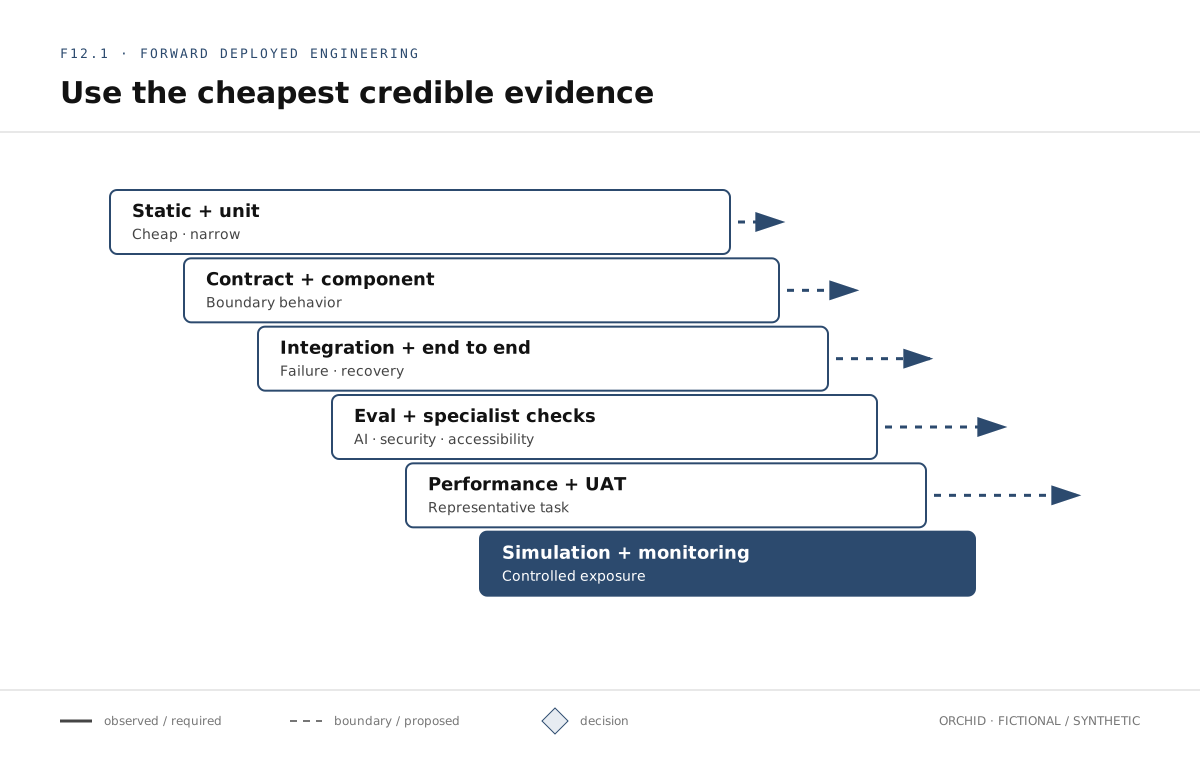
This selection rule and traceability matrix are original FDE synthesis tools, not a formal standard. [CLM-091]
Build OA-07 as a verification matrix
Each row contains:
- requirement, risk, control, or acceptance-criterion ID;
- exact criterion and consequence of failure;
- evidence type and method;
- data/fixture/user/environment provenance;
- system/config/policy/model/evidence versions;
- expected result and threshold owner;
- observed result, date, and evidence location;
- segment/cohort and uncertainty;
- known limitation/non-proof;
- pass/fail/inconclusive state;
- release disposition, owner, authority, waiver/expiry where relevant.
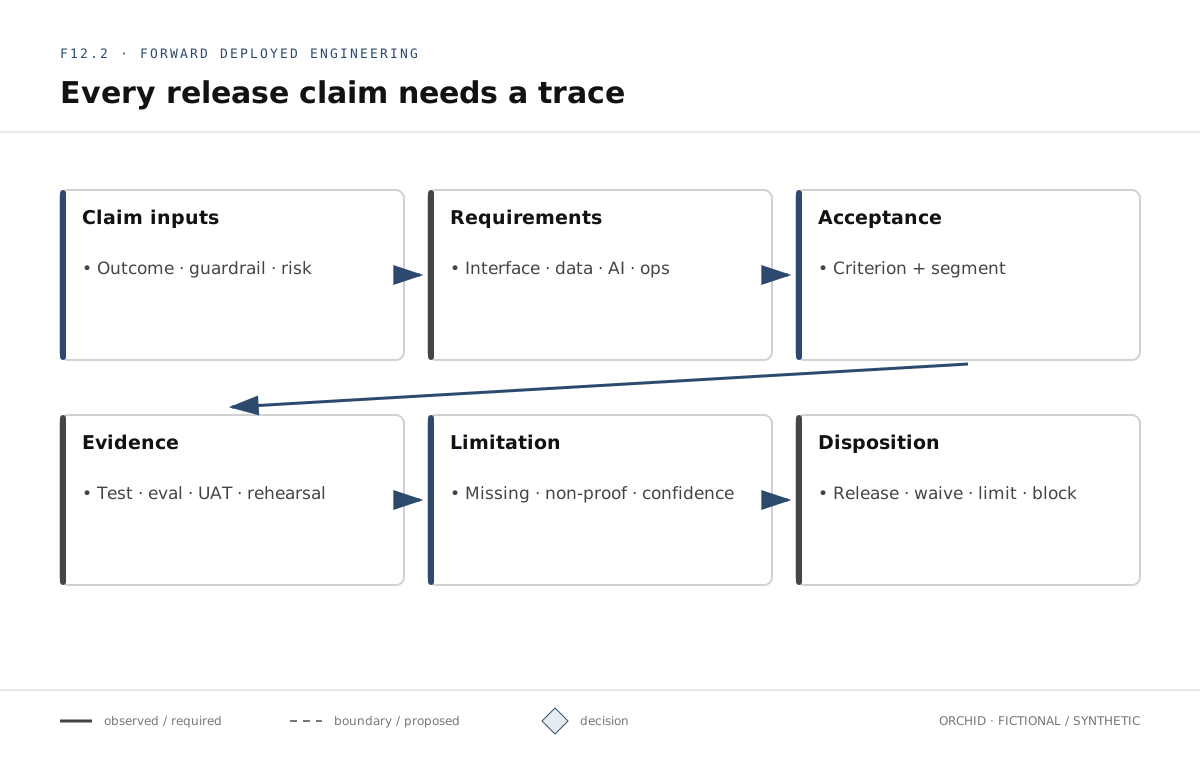
Do not write one row called “security testing” or “AI accuracy.” Decompose until a failed observation produces a meaningful action.
Example matrix rows
| Risk/claim | Criterion | Method/type | Current observation | Limitation/disposition |
|---|---|---|---|---|
| wrong equipment drives evidence | ambiguous equipment never reaches retrieval | end-to-end deterministic assertion | blocked before store call | synthetic fixture; candidate |
| external completion is misread | accepted/no response becomes reconciliation | contract/end-to-end deterministic assertion | reconcile with intent ID |
no real adapter; candidate only locally |
| prohibited suggestion reaches user | prohibited output is blocked for every critical case | deterministic policy plus segmented eval | local cases blocked | provider/adversarial coverage incomplete; no production release |
| unqualified safety approval | wrong tenant/region/expiry/permission denied | authorization negative tests | local denials pass | production identity/qualification mapping absent |
| audit leaks payload | event contains allowlisted fields only | deterministic assertion/static review | secret/raw payload absent | exporter/storage/access/retention untested |
| user cannot inspect evidence | representative users complete review task | task-based UAT/user acceptance | not yet observed | release of safety-relevant path blocked |
The last row is not a failed automated test. It is missing user evidence with release consequence. “Not tested” must remain distinct from passed.
Define criterion before running
Precommit the expected behavior, threshold, stop/waiver rule, and authority before seeing the result. Otherwise teams can move the target after an inconvenient failure.
For a statistical criterion, record numerator, denominator, exclusions, confidence/uncertainty method where meaningful, critical segment floors, and minimum sample adequacy. For a deterministic invariant, define exactly which versions and environments it covers. For expert judgment, define qualification/rubric/disagreement handling. For UAT, define task completion and unacceptable assistance or error.
Threshold selection is a risk/business/domain decision supported by evidence. The FDE can show tradeoffs and sensitivity but should not invent tolerance.
Keep evidence types distinct
The companion recognizes four types:
- deterministic assertion: for a fixed input/version/environment, a defined property held or failed;
- statistical estimate: observed rate/distribution with sample, segments, uncertainty, and assumptions;
- expert judgment: qualified reviewer decision under rubric and stated evidence;
- user acceptance: representative user completed or failed a defined task under recorded conditions.
These support different claims. Do not average them into one “confidence” score. [CLM-103]
Derive tests from risk and workflow state
Start from the workflow map, outcome contract, architecture, contracts, AI error taxonomy, and control matrix. For Orchid, the critical families are:
Binding and data
- missing/ambiguous/retired equipment;
- correct structure but wrong regional residency;
- stale/conflicting/missing manual;
- wrong equipment evidence returned by cache/index;
- source version changes;
- incomplete/duplicate/out-of-order data;
- cross-tenant/region query attempts.
Intent and dependencies
- same intent/same semantics replay;
- same intent/different semantics conflict;
- upstream success/downstream rejection;
- accepted request/no final response;
- late success after timeout;
- dependency timeout/unavailable/malformed response;
- rate/capacity constraint and retry amplification.
Identity and controls
- missing/expired identity;
- wrong tenant, region, resource, operation, or qualification;
- requester equals approver where separation is required;
- secret in configuration/log;
- feature disabled or wrong cohort;
- audit event missing or over-collecting;
- approval evidence complete but formal decision pending.
AI and review
- supported suggestion with correct evidence;
- unsupported statement or fabricated citation;
- prohibited/safety action;
- missing evidence requiring abstention;
- untrusted retrieved instruction;
- tool request outside permission;
- timeout/cost fallback;
- aggregate quality hiding a critical family failure;
- reviewer unable to inspect evidence or detect wrong context.
Operation and recovery
- signal/alert/runbook path for each material state;
- migration compatibility and partial deployment;
- rollback impossible after data change;
- backup present but restore invalid;
- break-glass dependency unavailable;
- support cannot identify release/config/policy bundle.
Chapter 12 records the method and current result; Chapters 13-14 build remaining signal/recovery evidence.
Layer the verification stack
No single layer dominates every claim.
Static analysis and review
Find suspicious source/config/dependency patterns, secret material, unreachable branches, unsafe defaults, and unclear ownership early. Static tools can produce false positives/negatives and cannot establish runtime semantics.
Unit and property tests
Challenge pure contracts, state transitions, authorization predicates, redaction, budgets, and invariants quickly. Add generated boundary inputs where useful. They do not prove adapter/environment behavior.
Contract tests
Verify provider/consumer expectations, examples, errors, compatibility, and semantic additions beyond schema. Test both sides when possible. A shared mistaken contract can still pass.
Integration/component tests
Exercise real protocol/identity/configuration and representative dependency behavior. Include denied, timeout, quota, partial, malformed, duplicate, and late-response paths. A test environment may still differ materially from production.
End-to-end tests
Trace representative user intent across components and controls. Keep a small consequential set: broad E2E suites can become slow, flaky, opaque, and expensive. Use lower layers for precise coverage.
Failure, load, and recovery evidence
Inject dependency impairment, concurrency, backpressure, retry amplification, capacity pressure, migration state, and recovery actions. Measure user-visible state and containment, not merely process survival.
Evaluation, security, accessibility, and UAT
Apply their specialized data, rubric, version, qualification, and user-context requirements. They complement the engineering stack rather than becoming an end-stage stamp.
When a high-level test fails, add a lower-level regression near the defect plus preserve the high-level case when it represents a consequential promise.
Control flakiness without erasing failure
Repeatedly rerunning until green destroys evidence. For each nondeterministic failure:
- preserve seed/input/system/environment and raw result;
- classify product defect, test defect, environment defect, or unknown;
- measure recurrence and segment;
- quarantine only with owner, consequence, expiry, and release rule;
- create a deterministic reproduction or improved diagnostic where possible;
- do not exclude the case from the aggregate without disclosure.
AI outputs may be probabilistic, but policy and authorization invariants can still be deterministic. For statistical behavior, run recorded trials, report distributions and failure classes, and retain critical failures instead of averaging them away.
Verify data and answer correctness separately
A query can execute successfully and still answer the wrong question. A retrieval can return a valid document and still bind the wrong equipment/version. Verify:
- source authority and provenance;
- selection/filter/join/binding semantics;
- freshness/completeness/consistency rules;
- missing/duplicate/conflicting states;
- transformation/aggregation meaning;
- tenant/region access;
- answer/evidence relationship;
- user interpretation and action.
ISO/IEC 25012’s official record supports use of a structured data-quality model, but Orchid’s concrete criteria and thresholds remain local. The book does not reproduce copyrighted requirements.
Plan representative performance evidence
Local execution time is not a capacity claim. Define workload from workflow evidence:
- arrival rate, concurrency, bursts, request sizes, cohort/site patterns;
- dependency quotas and connection pools;
- model/retrieval latency/cost distribution;
- timeouts, retries, cancellation, backpressure;
- warm/cold/cache conditions;
- data volume and migration/maintenance overlap;
- acceptable user-visible latency and fallback;
- capacity owner and scaling/stop action.
Measure tails and segments, not only averages. Verify that overload fails safely: reject/defer/fallback with truthful state rather than queueing invisibly, duplicating effects, or exhausting a shared dependency. Do not extrapolate production capacity from a laptop benchmark.
Test the contracts and their semantics
OpenAPI, AsyncAPI, and JSON Schema artifacts can anchor structural compatibility. Add semantic assertions for:
- resource/tenant/region binding;
- authorization and qualification;
- accepted/rejected/unknown completion;
- request intent equivalence/conflict;
- ordering, duplication, freshness, and reconciliation;
- error visibility and retry guidance;
- data-quality and provenance rules.
Schemas cannot prove that a valid equipment ID belongs to the ticket or that a timestamp is fresh enough for the decision. HTTP method semantics cannot make an external business effect safe to retry without application intent and completion rules. [CLM-092]
Use producer/consumer examples, negative cases, compatibility checks, and representative adapter tests. Freeze the contract version with the evidence result.
Design the AI evaluation as a system test
An evaluation needs explicit anatomy:
- task: bounded workflow behavior;
- case/trial: one context/input/evidence/permission state;
- dataset: versioned set with provenance and segments;
- grader/rubric: how acceptable/prohibited behavior is judged;
- trace/outcome: intermediate actions and final workflow result;
- harness: system bundle and execution/recording logic;
- suite: decision-relevant collection;
- purpose: capability, regression, release, diagnosis, or monitoring.
Portable concepts matter more than a vendor evaluation UI. [CLM-094]
Separate capability from regression
Capability asks whether an approach can satisfy the task under defined conditions. Regression asks whether a change preserves accepted behavior. [CLM-095]
An exploratory case can find a possible design. It should not automatically become the only release case. Curate validated cases, held-out and rotating variants, adversarial cases, stable high-consequence regressions, and new production-derived cases under permission/minimization.
Freeze the system bundle
Record:
- code/release and environment/config;
- model/provider/version/parameters;
- prompt/system instructions;
- retrieval corpus/index/chunking/ranking;
- tools/adapters and permissions;
- policy/authorization/approval;
- dataset and graders;
- latency/cost budgets;
- time and dependency versions.
A changed index or policy can invalidate a “same model” score.
Govern evaluation data
For every dataset/case record:
- source and permission;
- synthetic, constructed, public, customer-approved, or production-derived status;
- collection/construction procedure;
- version/change/correction history;
- development/validation/test/held-out/monitoring use;
- segment and consequence;
- leakage/tuning exposure;
- sensitive-data handling/retention;
- representativeness and known omissions.
The companion uses synthetic cases only. Production traces are not a free dataset. They may include customer content, identities, sensitive decisions, and model/provider retention issues.
Leakage changes the claim. A seen/memorized case can still be useful for regression but is weak independent capability evidence. [CLM-097]
Preserve segments and uncertainty
Suppose 99 common cases pass and one safety-critical equipment-family case fails. The aggregate is 99 percent. The release disposition is still blocked if the owner precommitted that critical failure as unacceptable.
Segment by legitimate decision factors such as:
- workflow consequence;
- equipment family;
- evidence quality/freshness;
- normal/exception/adversarial/fallback state;
- user role/qualification;
- tenant/region/site/connectivity;
- language or accessibility context;
- model/policy/version;
- latency/cost band.
Do not slice so finely that every cell hides uncertainty. Report sample counts, failure counts, disagreement, missing coverage, and uncertainty. Avoid false precision when examples are constructed or few.
An aggregate can conceal unacceptable segment failure. [CLM-096]
The companion verification report keeps common and safety-critical segments separate and blocks a critical failure even when most rows pass.
Calibrate graders
Deterministic graders
Use for exact invariants: schema, required evidence ID, prohibited action absent, policy state, permission, latency/cost budget, audit redaction, tenant/region binding.
Human/domain graders
Use for contextual usefulness, completeness, calibrated uncertainty, evidence interpretation, and workflow appropriateness. Record qualification, rubric, examples, order/blinding where feasible, disagreement, and escalation.
Model graders
Use only after comparing against qualified human labels across critical segments. Test prompt/order/verbosity sensitivity and shared failure modes. A model grader can prefer fluent unsupported answers or mirror the evaluated model’s blind spot.
The companion calibration output reports agreement and case-level disagreement instead of promoting a grader to authority. Graders need rubrics/calibration and are not objective by assumption. [CLM-098]
Add adversarial and misuse cases
Use the threat model to test:
- retrieved content instructing the model to ignore policy;
- cross-tenant evidence/reference injection;
- fabricated/stale tool results;
- encoded or indirect prohibited requests;
- secret/sensitive-data extraction attempts;
- permission and argument escalation;
- repeated calls exhausting budget/capacity;
- manipulation of evaluator or feedback data;
- reviewer automation bias and concealed evidence;
- malformed/oversized/unexpected interface input.
Security guides can prompt categories, but the cases must match Orchid’s architecture and workflow. Layered safeguards reduce risk; passing them does not establish a complete guarantee. [CLM-101]
Select security and accessibility evidence by version
With accountable owners, map relevant NIST SSDF/OWASP ASVS practices to implementation and verification. Record ASVS 5.0.0 selections, scope, result, gaps, and evidence rather than claiming broad alignment.
For WCAG 2.2, combine automated checks with keyboard, focus, semantics, zoom/reflow, error, and assistive-technology inspection plus real task evidence where appropriate. Passing selected criteria does not establish complete usability/accessibility for every context.
ISO product/data quality records can help organize attributes, but operational criteria/thresholds remain contextual. Versioned criteria support evidence, not automatic certification. [CLM-101]
Make UAT a protocol, not a demonstration
Define:
- representative roles, qualifications, contexts, devices/connectivity, and access needs;
- exact tasks and starting state;
- acceptance/guardrail criteria;
- data and environment;
- observation and evidence method;
- facilitation limits and assistance;
- issue severity, stop, retest, and sign-off path;
- participant consent/privacy and data handling;
- known non-represented users/conditions.
Observe whether the user can confirm equipment, distinguish evidence from suggestion, notice uncertainty, recover from fallback/reconciliation, exercise approval correctly, and find support.
UAT is not “we showed it and they liked it.” It does not transfer formal risk acceptance to participants. [CLM-102]
Work one Orchid UAT scenario
Role: a qualified technician reviewer using the intended device under degraded but supported connectivity.
Starting state: ticket has two plausible equipment candidates, one stale manual, current approved evidence for one candidate, and inventory whose first response is lost after acceptance.
The participant must:
- recognize ambiguity and avoid premature evidence/model access;
- resolve equipment using the approved workflow;
- inspect source/version and distinguish evidence from suggestion;
- handle the stale source visibly;
- route qualified approval under the correct regional permission;
- recognize unknown inventory completion and reconcile rather than resubmit;
- use fallback/support when the connectivity window is exceeded;
- complete the non-digital handoff and locate the audit/support record.
Acceptance evidence includes correctness, prohibited action absence, state interpretation, time within the owned window, assistance, fallback, accessibility observations, and participant reasoning at decision points. Stop if the protocol could create unsafe/external effects. Use synthetic or appropriately governed data.
A passing participant does not approve production risk. The result is one evidence row with stated representation and limitations.
Use simulation and monitoring for different evidence
Static evaluation may miss multi-step behavior, timing, tool interaction, reviewer workload, and operational adaptation. Deployment-like simulation can expose more of that path but still cannot reproduce every real user, dependency, adversary, workload, or production tail. [CLM-099]
Production monitoring remains necessary for data/workflow/model quality, drift, cohorts, latency/cost, fallbacks, overrides, support, security, and outcomes. Service availability alone cannot establish usefulness or trustworthiness. [CLM-100]
Do not use “we will monitor” to waive a foreseeable high-consequence control that should be verified before exposure. Monitoring detects after or during behavior; it is not always prevention.
Handle failures, limitations, and waivers honestly
Every failed/inconclusive row receives:
- consequence and affected segment;
- containment or scope restriction;
- root-cause/hypothesis status;
- remediation/verification owner;
- release effect;
- formal waiver authority if permitted;
- compensating controls and monitoring;
- expiry/retest trigger;
- evidence link and decision date.
Known limitations belong in the release packet, support material, and user/operator communication where relevant. A waiver cannot change an observed failure into a pass. [CLM-104]
The FDE prepares evidence/options. Designated authorities decide risk within delegated scope.
Conduct the chapter verification exercise
Start from five risks:
- wrong equipment/evidence binding;
- duplicate external effect after unknown completion;
- wrong tenant/region/qualification;
- prohibited or unsupported suggestion;
- low-connectivity timeout/retry amplification and unusable fallback.
For each, write the requirement/control, observable criterion, cheapest credible method, data/provenance/version, expected result, observed result, evidence type, segment, limitation, owner, and release disposition.
Then build evidence at several layers. A unit assertion can test a state transition. A contract test can test schema plus semantic invariants. An integration test can exercise adapter finality. End-to-end evidence can prove the bounded synthetic path. Evaluation can measure critical AI behavior. UAT can observe a representative workflow. Security/accessibility review can test versioned scoped criteria. Simulation can combine timing and failure. None replaces the others automatically.
Calibrate two graders against human labels. Preserve disagreements and inspect shared failure modes. If both model graders were trained on similar assumptions, agreement is not independence. Use the rubric and decision purpose to decide whether the grader is advisory, blocking, or unsuitable. [CLM-098]
Create an aggregate that appears to pass while one high-consequence equipment family fails. The correct disposition is not aggregate pass. Restrict release, repair or formally disposition the segment through designated authority, and keep the limitation visible. [CLM-096]
Finally, conduct the UAT scenario above and write one failed/inconclusive row. The exercise passes when the packet tells the release owner exactly which claims are supported, which are not, and what exposure those limitations permit.
Failure modes and repairs
Test count becomes confidence
Repair: trace consequence and requirement to credible observed evidence; keep suite conditions and non-proof explicit. [CLM-093]
Schema pass becomes semantic correctness
Repair: assert workflow meaning, authorization, quality, intent, finality, and reconciliation as well as structure. [CLM-092]
Aggregate conceals a critical segment
Repair: preserve segments, counts, uncertainty, and blocking disposition. [CLM-096]
Evaluation data leaks across decisions
Repair: provenance, permissions, versions, splits, leakage checks, correction history, and representativeness limits. [CLM-097]
Model grader becomes objective authority
Repair: explicit rubric, calibration, disagreement review, shared-failure analysis, and appropriate human/domain ownership. [CLM-098]
Demonstration becomes UAT
Repair: representative roles/tasks/context, predefined criteria, observed assistance, stop/retest, privacy, and limitations. [CLM-102]
Waiver erases failure
Repair: preserve failed observation, consequence, scope, conditions, owner, authority, expiry, and release effect. [CLM-104]
Orchid OA-07 current packet
The current companion provides 28 cumulative tests across:
- structure/semantics and region residency;
- missing/confirmed/ambiguous equipment;
- intent replay/conflict and unknown completion;
- authorization/qualified approval;
- environment/secret configuration;
- model abstention/budgets/policy;
- critical-segment evaluation;
- control evidence/authority/audit minimization;
- end-to-end success/rejection/reconciliation/default-closed feature;
- verification record completeness, evidence type, critical disposition, grader disagreement.
This is strong deterministic evidence for the synthetic local bundle. It is not evidence for real customer integrations, performance, production identity, UI/UAT/accessibility, provider-model quality, real monitoring, migration, release, or recovery. Those limitations remain explicit.
The Chapter 12 gate
Before release planning, OA-07 must contain:
- risk/requirement/control-to-evidence matrix;
- unit, property, contract, integration, end-to-end, failure, and recovery plans;
- AI task/case/data/grader/trace/harness/suite/purpose records;
- capability/regression and held-out/leakage boundaries;
- provenance/version/system bundle;
- consequential segments and uncertainty;
- grader calibration/disagreement;
- adversarial/security/accessibility selection and scope;
- task-based UAT protocol;
- observed results, limitations, owners, and disposition;
- waiver authority/expiry where allowed;
- passing local companion plus explicit non-proof.
The gate passes when every material release claim has the cheapest credible evidence available now or an explicit ownered limitation that restricts release.
Chapter 13, Make the System Observable and Operable, carries these claims and limitations into signals, objectives, alerts, diagnostic paths, runbooks, capacity/cost, and explicit blind spots.